



Table of Content
- What is hmb, exactly?
- What does the science actually say in 2026?
- Hmb and sarcopenia: the most promising angle
- What is the optimal dose?
- Who actually benefits from hmb?
- Hmb vs creatine vs leucine: what's the difference?
- What about just taking leucine?
- Does hmb have side effects?
- Practical integration into your qnt routine
- Conclusion
Last updated: April 11, 2026
"HMB builds 5 kg of muscle." "HMB is just expensive leucine." "HMB only works for older adults." These three claims circulate across the internet. None of them is entirely accurate. After more than two decades of research and the 2024 update of the ISSN position stand, HMB reveals a far more specific — and more useful — profile than most articles suggest. This guide explains exactly when HMB is worth your investment, at what dose, and in which contexts the science is strongest.
What Is HMB, Exactly?
HMB (beta-hydroxy-beta-methylbutyrate) is a natural metabolite of leucine, one of the three branched-chain amino acids (BCAAs). About 5 % of the leucine you eat through food is converted into HMB inside your body. That works out to roughly 0.2–0.4 g per day for an active adult — far below the doses used in studies (3 g/day).
An Anti-Catabolic, Not an Anabolic
Unlike creatine (which boosts power output) or whey protein (which delivers building blocks), HMB primarily acts as an anti-catabolic agent. It slows muscle breakdown rather than accelerating muscle construction. According to Wilson et al. (2013) — ISSN Position Stand on HMB, its mechanism involves inhibiting the ubiquitin-proteasome pathway and mildly stimulating mTORC1, the master regulator of protein synthesis.
Key takeaway: HMB protects the muscle you already have. It does not replace an adequate protein intake.
What Does the Science Actually Say in 2026?
HMB research took a turning point in 2024 with the updated ISSN Position Stand by Rathmacher et al. (2025). This revision compiled over 100 studies published since 2013 and delivered three key insights.
1. Confirmed Efficacy in Populations Under Catabolic Stress
The clearest benefits occur in three groups: resistance-training beginners, athletes in cutting phases, and older adults with sarcopenia. In these populations, HMB can contribute to limiting lean mass loss and may improve strength.
2. More Modest Benefits in Trained Athletes
In individuals with several years of training and a protein intake above 1.6 g/kg/day (see the Jäger et al. 2017 ISSN protein position stand), additional gains are harder to demonstrate. Studies suggest HMB becomes more valuable during training overload or temporary undernutrition.
3. Robust Safety Profile
The 2024 ISSN update confirms an excellent safety profile, even at 6 g/day for 8 weeks. No adverse effects on liver, kidney, or blood markers have been reported.
HMB and Sarcopenia: The Most Promising Angle
Sarcopenia — the progressive loss of muscle mass and strength with age — affects 10–30 % of adults over 60. This is where HMB shines. A 2024 meta-analysis in Frontiers in Nutrition (Courel-Ibáñez et al.) pooled multiple randomized controlled trials: in seniors combining resistance exercise with HMB, improvements in grip strength and gait speed were significantly greater than placebo.
2023 RCT Evidence
A double-blind randomized controlled trial published in 2023 (Lin et al., PMID 37248756) followed adults aged 60+ with sarcopenia over 12 weeks. The HMB group (3 g/day) showed significant improvements in grip strength, muscle quality, and the chair stand test — with no side effects.
Who benefits? Active seniors, individuals recovering from hospitalization, or anyone entering their 50s who starts noticing strength decline. If that sounds like you, our complete guide to supplements for healthy aging pairs perfectly with this article.
What Is the Optimal Dose?
The answer has been stable since the early 2000s: 3 g per day, or about 38 mg/kg of body weight.
How to Take HMB
| Timing | Dose | Paired With |
|---|---|---|
| Breakfast | 1 g | Meal + protein |
| Pre-workout | 1 g | Pre-workout drink or whey |
| Dinner | 1 g | Meal + protein |
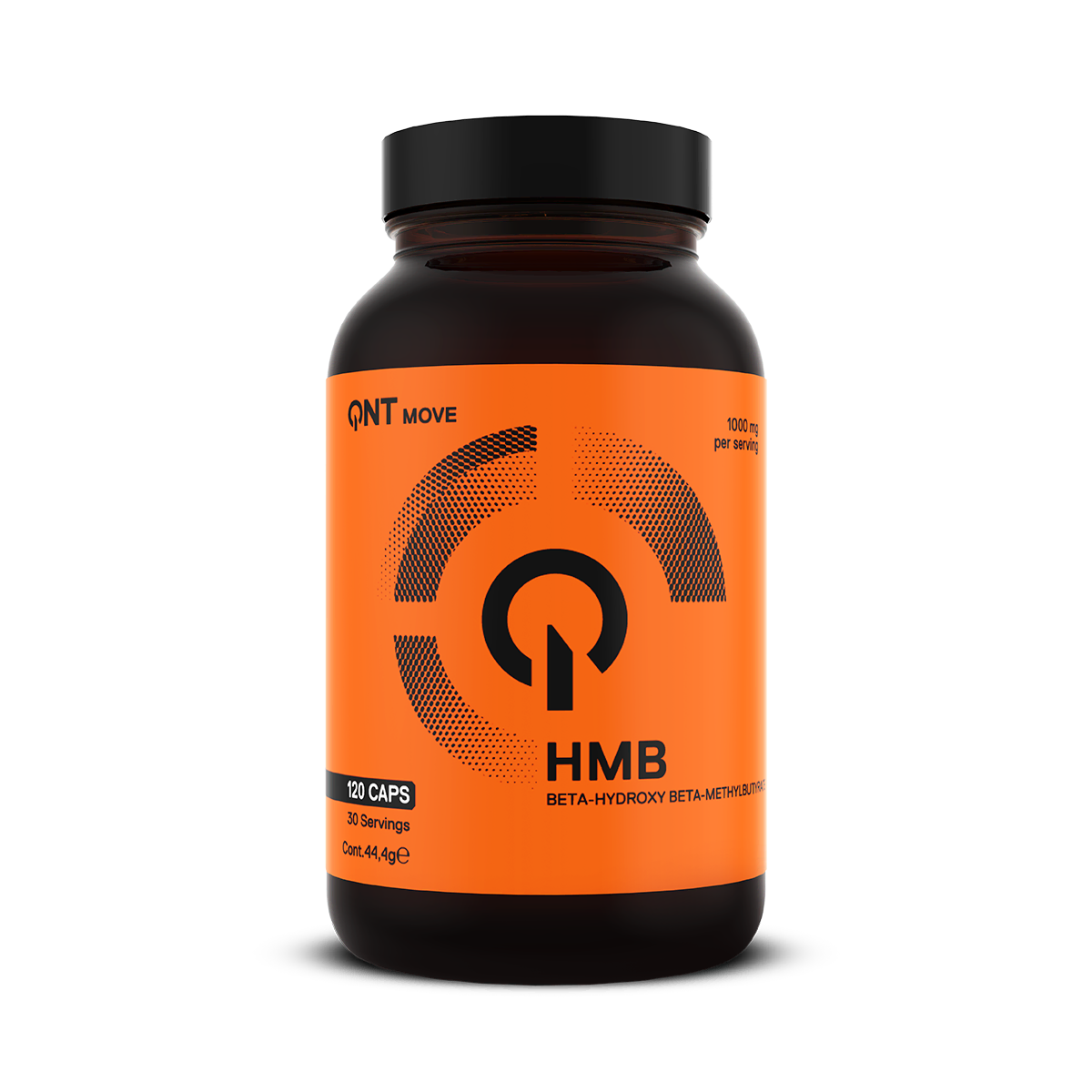
HMB is well absorbed in capsule form. The HMB-Ca (calcium-HMB) form, used in the majority of studies and found in our QNT HMB 1000 mg 120 capsules, is the ISSN-validated reference. No "loading phase" is needed: muscle stores saturate within 2–3 weeks of consistent use.
Who Actually Benefits From HMB?
Here is the decision table other sites won't give you, built from current research.
| Profile | Expected Benefit | Verdict |
|---|---|---|
| Beginner lifter | Moderate lean mass and strength gains | ✅ Worth it |
| Trained athlete with optimal nutrition | Marginal gain in normal conditions | ⚠️ Context-dependent |
| Cutting phase (caloric deficit) | Preserves lean mass | ✅ Very useful |
| Post-injury recovery or immobilization | Reduces muscle loss | ✅ Very useful |
| Senior (sarcopenia, frailty) | Strength and muscle quality gains | ✅ Very useful |
| Training overload | Reduced muscle damage markers | ✅ Useful |
HMB vs Creatine vs Leucine: What's the Difference?
This is the most common reader question, and it deserves a clear table.
| Criterion | HMB | Creatine Monohydrate | Leucine |
|---|---|---|---|
| Primary role | Anti-catabolic | Increases ATP/strength | Protein synthesis trigger |
| Studied dose | 3 g/day | 3–5 g/day | 2–3 g/meal |
| Best profile | Beginners, seniors, cutting | Any explosive athlete | Low-protein diets |
| Monthly cost | €€ | € | €€ |
| QNT priority | Targeted supplement | Non-negotiable base | Already in your whey |
Should You Combine HMB and Creatine?
A 2025 crossover study (PMID 41073834) compared HMB alone, creatine alone, and the combination in active older adults. The combination improved functional strength independently of muscle mass. Practical conclusion: if your goal is preserving muscle function with age, pairing QNT Creatine Monohydrate with 3 g of HMB makes sense. For a young, trained athlete, creatine alone covers 90 % of cases. See our creatine before or after workout guide for dosing.
What About Just Taking Leucine?
Fair question. HMB is a leucine metabolite — but only a small fraction of ingested leucine is converted. Wolfe (2017) reminds us that leucine alone is insufficient to maximize protein synthesis without a complete amino-acid pool. If your protein intake is already around 1.6–2 g/kg (via Metapure Whey Isolate Zero, for example), adding HMB can provide a benefit where adding leucine alone would not. For a deeper dive into BCAA-driven recovery, see our complete BCAA guide.
Does HMB Have Side Effects?
Short answer: no, not at recommended doses. The 2013 ISSN position stand and its 2024 update converge: HMB is well tolerated up to 6 g/day for 8 weeks, with no disruption of liver, kidney, or blood markers. Like any food supplement, HMB should be integrated into a balanced and varied diet, and pregnant, breastfeeding, or medicated individuals should consult their healthcare provider before use.
Practical Integration Into Your QNT Routine
If HMB seems relevant to you after reading this guide, here is how to smartly integrate it into your QNT program.
Scenario 1 — Spring/summer cut: 3 g HMB + 1.8–2 g/kg protein (via Metapure Whey Isolate Zero) + moderate caloric deficit.
Scenario 2 — Active senior: 3 g HMB + QNT Creatine Monohydrate + 2 resistance sessions per week. This is the best-documented combination for sarcopenia.
Scenario 3 — Post-injury recovery or long flight: 3 g HMB for 4–6 weeks starting at the return to activity. Glutamine may complement this phase.
Scenario 4 — Motivated beginner: 3 g HMB during the first 8 weeks if your protein intake is temporarily insufficient (travel, routine change), then reassess.
Made in Belgium since 1992, our HMB 1000 mg in 120 capsules is dosed to cover exactly 30 days at 4 capsules/day (i.e. 4 g/day — within the ISSN-validated range). Simple, transparent, no frills.
Conclusion
HMB isn't the star supplement marketers sometimes claim it is, but it is a precise tool: genuinely useful in well-defined contexts (cutting, sarcopenia, recovery), more modest in the trained, well-fed athlete. The 2024 ISSN update finally clarifies those nuances. At QNT Sport, we believe the best way to help you is to tell the truth: HMB is worth the spend if your profile matches, not as a universal supplement.
Want to try it? Discover our HMB 1000 mg 120 capsules, made in Belgium to our quality standards since 1992.
This article is for informational purposes only and does not replace medical advice. Food supplement — to be integrated into a balanced and varied diet.