




Electrolytes for Athletes: Do You Need Them, and How Do You Choose?
Table of contents
- 1. what exactly is an electrolyte?
- 2. how much do you really lose through sweat?
- 3. the scale test: measure your own sweat rate
- 4. do you really need electrolytes?
- 5. do electrolytes prevent cramps?
- 6. the real risk: drinking too much
- 7. how to choose: the eu's official reading grid
- 8. isotonic drink or electrolyte product? two different tools
- 9. homemade isotonic drink: the recipe and its limits
- 10. beyond endurance: the gym, heat, everyday life
- Conclusion

Last updated: 22 July 2026
There are many beliefs about electrolytes. Among the most common: electrolytes prevent cramps, you have to drink them every session, and the more you get the better. All three claims are false, yet you will still read them on almost every website that sells electrolytes. The reality is more useful: in many situations plain water is plenty, and when it no longer is, a single mineral is the one that truly counts. Here is what the recommendations from the ACSM (American College of Sports Medicine), the NATA (National Athletic Trainers' Association) and the EFSA (European Food Safety Authority) actually say about electrolytes and sport, and how to read a label without getting fooled.
1. What exactly is an electrolyte?
An electrolyte is a mineral that carries an electric charge once it dissolves in the body's water. A mineral is a nutrient the body does not make on its own and has to obtain from food. That charge is precisely what makes electrolytes useful for performance: it lets your body conduct the nerve signals that command your muscles, trigger each muscle contraction, and distribute water between the inside and the outside of your cells. When this balance is thrown off, signal transmission degrades, contractions lose power, and fatigue arrives sooner. The four that matter to an athlete are sodium, potassium, magnesium and calcium, plus chloride.
Not all of them are equal, though that is not always clear in the articles that talk about electrolytes. Only one is lost in a truly significant amount in sweat: sodium.
| Electrolyte | Physiological role | Loss in sweat | EU-authorised claim |
|---|---|---|---|
| Sodium | Water distribution, blood volume, intestinal water absorption | High | No "health" claim: a nutrient to limit in the general diet |
| Potassium | Muscle function, nervous system, normal blood pressure | Moderate | Contributes to normal muscle function and to normal functioning of the nervous system |
| Magnesium | Muscle function, energy metabolism, fatigue | Low to moderate | Contributes to normal muscle function, normal energy metabolism and the reduction of fatigue |
| Calcium | Muscle contraction, blood clotting | Low | Contributes to normal muscle function |
| Chloride | Acid-base balance, accompanies sodium | High | Contributes to normal digestion |
The takeaway: sodium is the only electrolyte you lose enough of for an intake during the session to have a meaningful effect on training quality. Magnesium and calcium matter for your health, but you do not lose enough of them in an hour of exercise to justify a special drink.
2. How much do you really lose through sweat?
Before we talk about losses, let us recall what sweating is for: it is the body's cooling system. As it evaporates at the surface of the skin, sweat carries off the heat produced by your muscles and keeps your core temperature in a safe zone. The electrolytes, sodium first among them, leave with that water. Even so, you sweat far less than you are led to believe over a normal session, and far more than you imagine over a long effort in high heat. That is the whole nuance.
The reference data, from the review by Shirreffs and Sawka published in the Journal of Sports Sciences, is unambiguous about the extreme cases: in active athletes exposed to heat, daily losses can reach 4 to 10 litres of water and 3,500 to 7,000 mg of sodium (Shirreffs & Sawka, 2011). At that level, water alone obviously no longer suffices to replace the sodium losses or to maintain blood volume and performance. But those figures correspond to extreme conditions, a full day of intense heat, a world away from a 50-minute session in an air-conditioned gym.
Your sweat looks like no one else's. The review by Baker in Sports Medicine shows that sweat rate and sweat sodium concentration vary enormously from one person to the next, and even within the same person from one session to another, depending on heat, acclimatisation, intensity and diet (Baker, 2017). No generic table, then, can tell you what you should drink.
The simplest sign: white marks. If after a session you find white deposits on your skin, your cap or your shirt, if your sweat stings your eyes or tastes distinctly salty, you are probably a "salty sweater". You lose more sodium than average, and you are the profile for whom electrolytes are likely to make a difference.
3. The scale test: measure your own sweat rate
You are not always told to "individualise your hydration", but there is a clear scientific consensus: hydration should be individualised. Here is how to do it concretely, in a single session. The ACSM recommendations call precisely for this kind of individualised strategy, based on the change in body mass (Sawka et al., 2007).
- Weigh yourself naked, right before the session, after going to the toilet. Note the weight in kg.
- Train as usual. Note everything you drink during the session, in litres.
- Weigh yourself naked right after, once you have sponged off surface sweat. Note the exact duration.
- Calculate: fluid loss (L) = (weight before - weight after) + volume drunk. Divide by the duration in hours for your sweat rate in L/h.
Example. You weighed 75.0 kg. After 1 h 30 of running, you weigh 73.8 kg and you drank 0.5 L. Loss = (75.0 - 73.8) + 0.5 = 1.7 L in 1.5 h, or about 1.13 L/h.
| Sweat rate | Interpretation | Practical recommendations |
|---|---|---|
| < 0.5 L/h | Low sweat rate | Water is enough in the vast majority of cases |
| 0.5 to 1.0 L/h | Moderate sweat rate | Water up to 1 h, electrolytes beyond that or in high heat |
| 1.0 to 1.5 L/h | High sweat rate | Electrolytes recommended from 1 h of effort |
| > 1.5 L/h | Very high sweat rate | A structured sodium strategy, especially on long efforts |
4. Do you really need electrolytes?
Plain water and an electrolyte drink do not do the same job. Water rehydrates and replaces the volume you lost; an electrolyte drink mainly adds sodium, and sometimes carbohydrates. But over a short, temperate session, sodium losses stay small compared with what your daily diet already provides. That is why, in most cases, water is enough: the sodium a drink adds fills no real gap. Only when losses climb, with duration, heat or heavy sweating, does electrolyte intake become useful.
For most sessions under an hour, in temperate conditions, water is enough. This is not an opinion, it is what comes out of the ACSM and NATA recommendations: electrolytes become relevant when the effort runs long, when the heat rises, or when sweating is heavy. Selling an electrolyte drink for a one-hour weights session in an air-conditioned gym is marketing, not physiology.
| Situation | Duration | Conditions | What you need |
|---|---|---|---|
| Weights, gym | < 1 h 15 | Temperate | Water |
| Running, cycling | < 1 h | Temperate | Water |
| Running, cycling, swimming | 1 h to 2 h | Temperate | Water, or electrolytes if a "salty sweater" |
| Any sport | > 1 h | Heat, humidity | Electrolytes + carbohydrates |
| Endurance, trail, triathlon | > 2 h | All | Electrolytes + carbohydrates |
| Team sports, tournament | Full day | Heat | Electrolytes, across the day |
| Recovery after a big loss | after effort | Loss > 2% of body weight | Electrolytes + water + protein |
The takeaway: the only two situations that make electrolytes genuinely useful are duration beyond one hour and heat. Neither intensity alone, nor simply sweating a little, is enough to justify them.
5. Do electrolytes prevent cramps?
No, not according to current data. This is the most widespread claim on the market, and it is the one that holds up least. It has to be said plainly, even by someone who sells sports drinks.
The idea that cramps come from an electrolyte deficit or from dehydration is an old hypothesis, widely circulated, but one that has never been solidly demonstrated. The work of Schwellnus, published in the British Journal of Sports Medicine, concludes that the "dehydration" and "electrolyte deficit" hypotheses offer no plausible physiological mechanism able to explain what is observed in athletes (Schwellnus, 2009). This finding is not isolated. In distance runners, serum electrolyte concentration and hydration status did not differ between those who cramped and those who did not (Schwellnus et al., 2004). The same result was found in Ironman triathletes: serum sodium, potassium and magnesium concentrations were comparable between athletes prone to cramps and those free of them (Sulzer et al., 2005).
What science proposes instead. The explanation that holds up today is altered neuromuscular control. When a muscle tires, the balance between excitatory signals (the muscle spindle) and inhibitory signals (the Golgi tendon organ) is disrupted. If the contraction continues, the cramp strikes. It is a problem of fatigue and nervous control, not of mineral stores. That explains why cramps hit the muscles that are working, occur late in the effort, and ease with stretching.

The takeaway: cramps are not solved with electrolytes, and no serious product should promise that. What electrolytes genuinely deliver lies elsewhere, and it is already a great deal: they support fluid balance, help water absorption during exercise, and contribute to maintaining performance on prolonged endurance efforts. Real benefits, measured, and recognised by European regulation.
6. The real risk: drinking too much
While you are being worried about cramps, the real hydration danger is the opposite: exercise-associated hyponatremia, a dilution of blood sodium caused by drinking too much. The NATA recommendations are explicit: both an insufficient intake and an excessive one compromise performance and raise the risk. That risk is hyponatremia: a dangerous drop in blood sodium. It should be suspected when body weight is maintained or increases during an effort of an hour or more (McDermott et al., 2017). If you finish a race heavier than you started, unless you ate something in between, it usually means you drank too much.
The signs: headache, nausea, bloating, confusion, swelling of the hands or face, weight gain during the effort. If there is serious doubt, it is a medical emergency. The simple rule: drink to your thirst and to your measured sweat rate. The same reasoning applies to supplements said to make you thirsty: see our article Creatine and water: how much should you drink per day for optimal results?.
7. How to choose: the EU's official reading grid
Before we open the table, a word on claims. A claim is a statement that attributes to a product an effect on health or performance ("contributes to normal muscle function", for example). In the European Union these statements are not free for the taking: a claim is authorised only if the EFSA judged the scientific evidence sufficient, and it is then entered in an official register. Its role is to protect the consumer from unverifiable promises; its usefulness to you is simple: it separates what a product may legally state from what is pure marketing.
In the European Union, a drink may only carry the "carbohydrate-electrolyte solutions" claims if its composition meets precise conditions, set by Regulation (EU) No 432/2012 on the basis of the EFSA opinion (EFSA, 2011). These are the only official quantified criteria that exist.
| Criterion (per litre ready to drink) | Required value | What it ensures |
|---|---|---|
| Energy from carbohydrates | 80 to 350 kcal/L | Provides energy without slowing digestion |
| Share of high glycaemic index (GI) carbohydrates | at least 75% of the energy | Quickly available sugars (glucose, sucrose) |
| Sodium | 460 to 1,150 mg/L (20 to 50 mmol/L) | The threshold that triggers water absorption |
| Osmolality | 200 to 330 mOsm/kg of water | Concentration close to blood, for good tolerance |
Two claims are authorised, and no others: "contribute to the maintenance of performance during prolonged endurance exercise" and "enhance the absorption of water during physical exercise". Nothing about cramps, nothing about recovery, nothing about fatigue.
How to apply it. Labels show values per serving, never per litre. Bring everything back to the litre: find the powder dose and the water volume, locate the "Salt" line, then sodium (mg) = salt (g) ÷ 2.5 × 1,000, and divide by the volume in litres. Example: 0.50 g of salt per 30 g in 500 ml = 200 mg = 400 mg/L, below the 460 mg/L floor.
8. Isotonic drink or electrolyte product? Two different tools
| Isotonic drink (carbohydrate-electrolyte) | Electrolyte product (sodium tablet/capsule) | |
|---|---|---|
| Purpose | To provide energy and help water absorption | To provide sodium, with little or no calories |
| Carbohydrates | 80 to 350 kcal/L | Little or none |
| Sodium | Moderate to high | High, it is the heart of the product |
| What for? | To support endurance efforts where fuel matters as much as fluid | To offset heavy sodium losses: heavy sweaters, high heat, very long efforts |
| The trap | Thinking it replaces a sodium strategy | Thinking it provides energy |
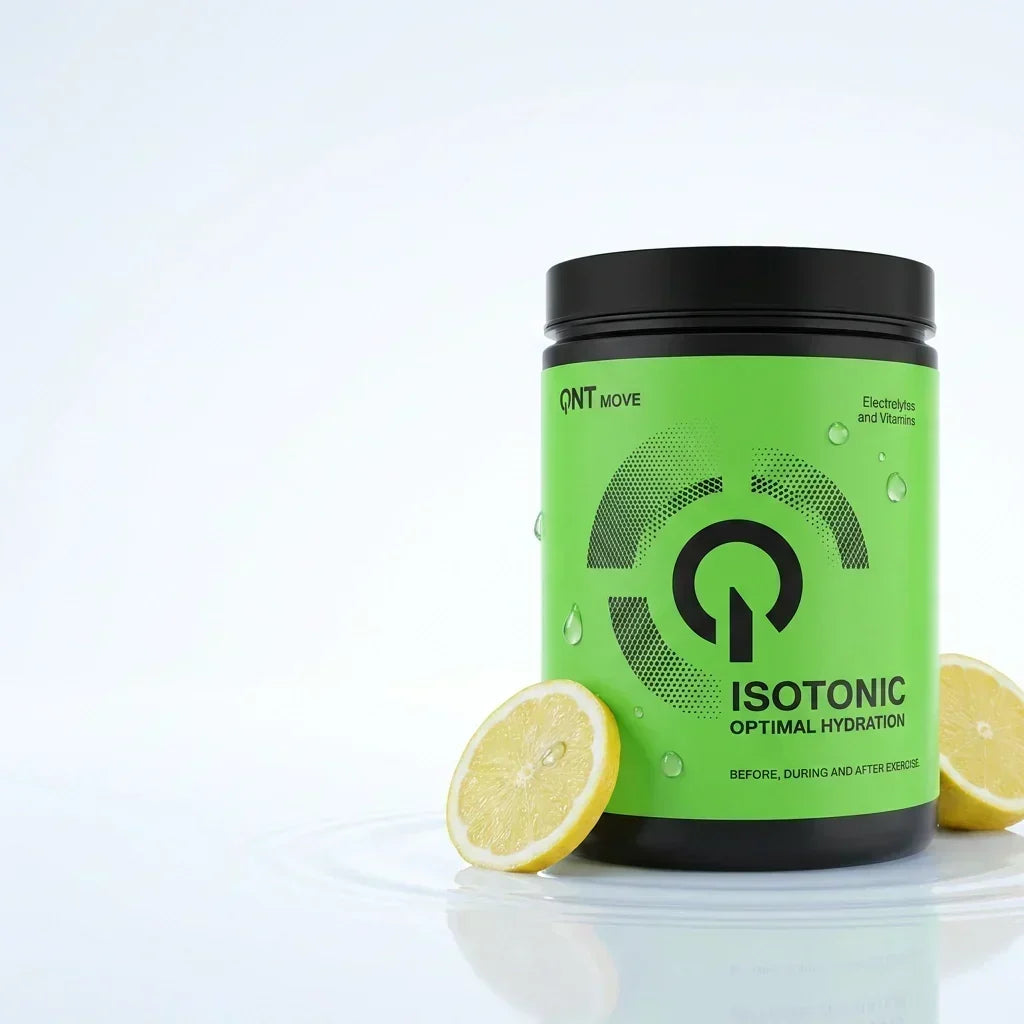
Where QNT Isotonic fits. Our Isotonic Powder is an endurance carbohydrate drink: about 25 g of carbohydrates and 104 kcal per 30 g of powder to dilute in 500 ml of water, with magnesium, calcium, phosphorus and chloride, plus 100% of the reference intake for vitamins B1, B2, B3, B5, B6, C and E. It is the right tool when your problem is energy and water absorption over a 1-to-3-hour effort. If you are a very heavy sweater, go out for more than 3 hours, or train in high heat, top up your sodium strategy. For magnesium day to day, see Magnesium Sport or Calcium-Magnesium-Zinc in the Vitamins & Minerals collection.
9. Homemade isotonic drink: the recipe and its limits
| Ingredient (per 1 L) | Quantity | Contribution |
|---|---|---|
| Water | 1 L | Base |
| Grape or apple juice | 150 to 200 ml | 25 to 35 g of carbohydrates |
| Sugar or glucose syrup | 30 to 40 g | Carbohydrate top-up |
| Fine table salt | 1.2 to 1.5 g (≈ 1/4 tsp) | 480 to 600 mg of sodium |
| Lemon juice | to taste, to each person's preference | Flavour, acidity |
You end up with ~60 g of carbohydrates/L (nearly 240 kcal/L) and 480 to 600 mg of sodium/L, within the official ranges. But: the osmolality is not controlled, the carbohydrate profile is less effective than a properly balanced glucose-fructose mix, there are no vitamins, and the taste gets old fast. Verdict: for 1 to 2 hours, the homemade drink does the job very well. For competition, long efforts or heat, a formulated product remains more reliable.
10. Beyond endurance: the gym, heat, everyday life
In the gym: in the vast majority of cases, water is enough. It is enough to cover your hydration needs during the session. Magnesium is still useful to your muscle health, but it is the daily intake that makes the difference, not an intra-session drink. In high heat: this is the case where electrolytes move from "nice to have" to "relevant"; see our guide to training safely in high heat. Everyday: if you eat normally, your diet covers your needs, and the EFSA sets adequate water intake at 2.0 L/day (women) and 2.5 L/day (men), from all sources combined (EFSA, 2010). Three exceptions: prolonged heat, a very low-carbohydrate diet, and digestive losses linked to illness.
Conclusion
Remember three things. Sodium is the only electrolyte that really counts during exercise. Cramps are not solved in a bottle. And the only objective way to read a label is the EU's: 80 to 350 kcal/L, 460 to 1,150 mg of sodium per litre, 200 to 330 mOsm/kg. Discover our Endurance collection and our Vitamins & Minerals range, formulated in Belgium since 1992.

Written by the QNT Sport team, over 30 years of expertise in sports nutrition. Reviewed by Marius Grek.
Sources
Shirreffs & Sawka 2011 (DOI) · Sawka et al. 2007, ACSM (DOI) · McDermott et al. 2017, NATA (DOI) · Schwellnus 2009 (DOI) · Schwellnus et al. 2004 (PubMed) · Sulzer et al. 2005 (PubMed) · Baker 2017 (DOI) · EFSA 2011 (link) · EFSA 2010 (DOI) · Examine.com
Frequently asked questions
Should you drink electrolytes at every workout?
Do electrolytes really prevent cramps?
What sodium level should you look for?
Can you take too many electrolytes?
Isotonic drink or tablets?
Is a homemade drink as good as a shop-bought one?
Does magnesium help during exercise?
Keep reading
Exercising in a Heat Wave: The Do's and Don'ts for Training Safely
Exercising in a heat wave? Learn the do's and don'ts: smart timing, hydration, electrolytes and recovery to train safely when temperatures soar.
 entrainement
What to eat before a workout? The pre-workout meal guide
What to eat before a workout? A meal, a pre-workout snack or a small bite depending on the time available, with simple examples and the right carbs.
How Much Water to Drink With Creatine: What the Science Really Says
How much water to drink with creatine? You don't need litres extra, just normal hydration. Get the science-backed facts, the formula and expert tip...
 Improve Performance
Running nutrition: the complete runner's fueling guide
Running nutrition explained: pre-run carbs, in-race gels, hydration, recovery, and iron for female runners. Evidence-based guide by QNT Sport.
 Improve Performance
Football nutrition: the complete player's fueling guide
Football nutrition explained: pre-match fuel, in-game hydration, 72h recovery and sport-specific supplements. Evidence-based guide by QNT Sport.


