





Glutamine benefits, dosage and muscle recovery: complete guide 2026
Table of contents

Last updated: July 13, 2026
After an intense training session, your glutamine levels can drop by 30 to 50%. This amino acid, the most abundant in your muscles, plays a central role in recovery and immune support. Yet while many athletes supplement with glutamine, few really know how to use it at the right time and the right dose. In this guide, we break down what the scientific studies say about glutamine benefits, the optimal dosage for your goal, and how to fit it intelligently into your routine.

What is glutamine?
Glutamine is an amino acid. Amino acids fall into two groups: essential amino acids, which the body cannot make and must obtain from food, and non-essential amino acids, which the body can synthesise on its own. Glutamine belongs to the second group: under normal conditions your body produces enough of it. It accounts for roughly 60% of the free amino acids in muscle tissue and is also found in blood plasma, the brain and the digestive system.
That classification is not absolute, however. Under intense physical stress (strength training, prolonged endurance work or a calorie-restricted phase such as a cutting diet), demand can outpace production. This is why some researchers describe glutamine as "conditionally essential": in these specific contexts, dietary intake or supplementation can become useful, whereas it is not needed at rest.
The two forms of glutamine
In supplement form, glutamine mainly comes in two versions, which differ in stability and absorption:
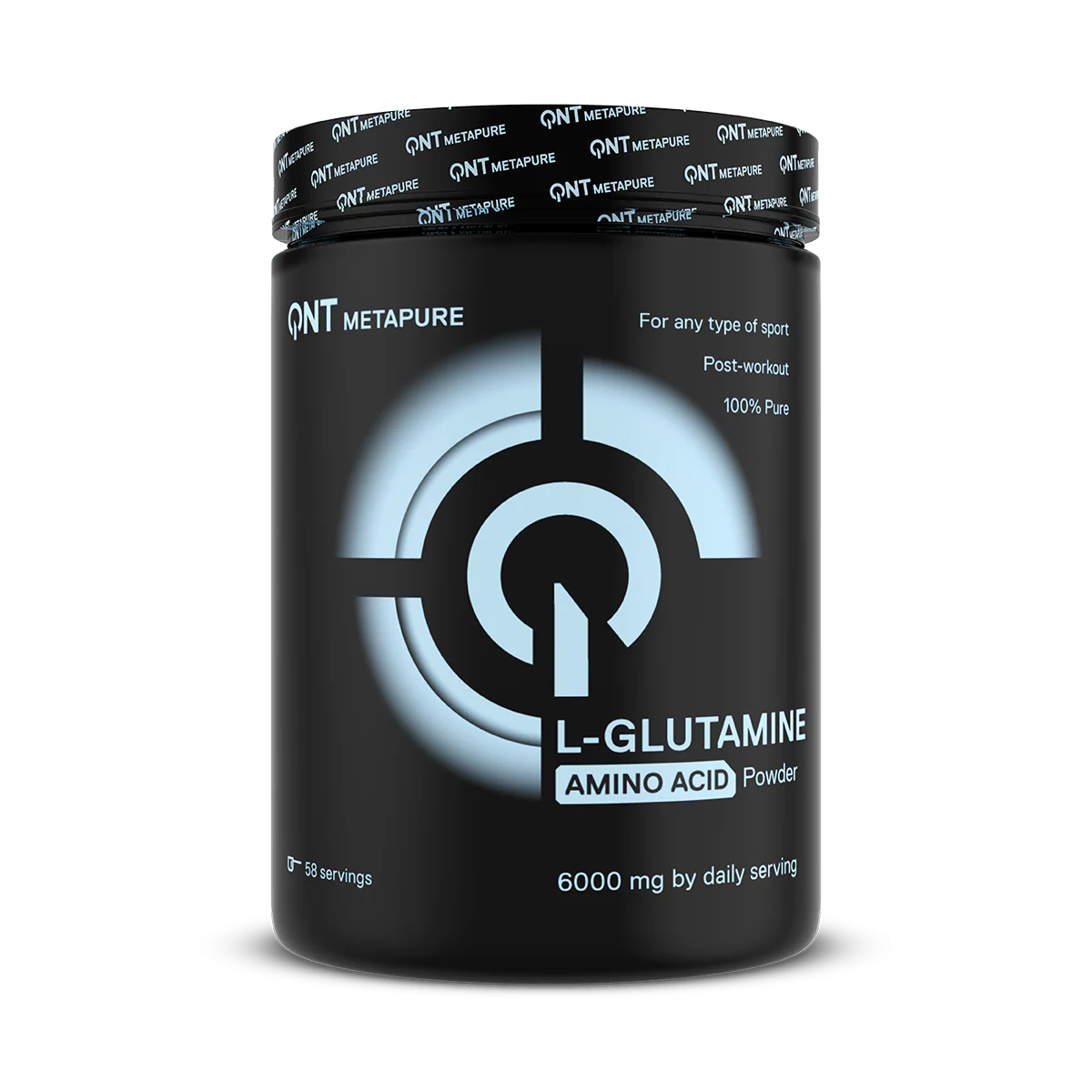
- Free L-Glutamine: the most common and least expensive form. It is effective but slightly less stable in solution. This is the form used in QNT L-Glutamine 6000 mg.
- Glutamine peptides (bound to another amino acid, often L-alanine): more stable and sometimes better absorbed post-exercise, but more costly. For most athletes, the free form remains a sound and economical choice.
Glutamine vs protein: what is the difference?
The ISSN (International Society of Sports Nutrition, the leading scientific body in sports nutrition) recommends 1.4 to 2.0 g/kg/day of protein for active individuals. Whey naturally contains some glutamine, but only in modest amounts. Targeted glutamine supplementation therefore does not replace adequate protein intake: it complements it in specific situations, when training volume is high, during a cutting phase, or in prolonged endurance work.
Jäger et al. (2017). ISSN position stand: protein and exercise. Journal of the International Society of Sports Nutrition.
What are the benefits of glutamine for athletes?
The benefits of glutamine centre on three main areas: muscle recovery, immune support and gut health.
Muscle recovery
Recovery is the number-one reason athletes supplement with glutamine, especially during a cutting phase, when the metabolic context (calorie deficit, heavy training) can reduce glutamine availability in the muscle.
In a randomised controlled trial, Legault et al. (2015) studied 16 untrained men split into two groups (glutamine at 0.3 g/kg versus placebo) after eccentric exercise. Eccentric exercise is the phase in which the muscle lengthens under tension, for example the lowering phase of a squat or a curl: it is the phase that causes the most muscle micro-damage and soreness. The glutamine group regained their peak strength faster than the placebo group, and their muscle soreness was lower at 24, 48 and 72 hours after exercise.
The proposed mechanism is as follows: by supporting the replenishment of muscle stores and limiting certain markers of damage, glutamine appears to speed up the restoration of muscle function. A review by Córdova-Martínez et al. (2021) points in the same direction, reporting a reduction in muscle-damage markers after supplementation in athletes.
Key takeaway: Glutamine does not directly build muscle. Its value lies in shortening recovery time between sessions, which can indirectly support training consistency.
Immune support
Intense, prolonged training can temporarily weaken certain immune defences. Glutamine is an important energy substrate for immune cells. In his reference review, Gleeson (2008) analysed several trials in endurance athletes: glutamine supplementation (0.1 to 0.3 g/kg) appears to help support immune function after intense exercise, though results vary across protocols. A broader review by Cruzat et al. (2018) confirms glutamine's role as a preferred fuel for immune and intestinal cells, while stressing that the benefits depend on context (training load, nutritional status).
Gut health
Glutamine is the primary "fuel" for the cells lining the gut wall. Studies suggest it may help maintain the integrity of the intestinal mucosa: Kim & Kim (2017) and the review by Cruzat et al. (2018) report a role for glutamine in supporting the gut barrier, a point that is especially relevant for endurance athletes prone to digestive discomfort during effort.
What glutamine does not do
Because glutamine is the most abundant amino acid in muscle, one might assume that extra intake promotes muscle gain. That is not what the data show: unlike branched-chain amino acids (BCAAs) or leucine, which directly stimulate muscle protein synthesis, glutamine does not appear to directly increase muscle mass or strength. The meta-analysis by Ramezani Ahmadi et al. (2019) found no significant effect of glutamine on body composition in healthy adults. Its main role therefore remains recovery, immune support and gut health.
How much glutamine should you take?
The guidance below applies to healthy adults who train regularly. It is indicative only: needs vary with body weight, training volume and goal. If in doubt, or if you have a specific health condition, ask a healthcare professional for advice.
For most athletes, a dose of 5 g per day is a reasonable starting point, whether for general maintenance, recovery or supporting the gut (ideally in the morning on an empty stomach in the latter case). During periods of intense training or cutting, this dose can be raised to 10 g per day, ideally within 30 minutes after the session.
Protocols aimed at immune support in endurance athletes use doses expressed per kilo of body weight, in the range of 0.1 to 0.3 g/kg per day, split into two or three servings. For a 70 kg person, that works out to roughly 7 to 21 g per day. These higher doses apply to specific contexts and are not necessary for everyday use.
QNT L-Glutamine 6000 mg delivers 6 g per scoop, a practical benchmark close to the most common recommendations. 
When and how to take glutamine
- After training (within 30 min): this is the timing used in most recovery studies (including Legault et al. 2015), which give glutamine right after exercise. No data show that another time of day is less effective, though; what matters most is your total daily dose.
- Morning on an empty stomach: a practical option if you are targeting gut comfort, since glutamine fuels the cells lining the gut (Cruzat et al. 2018). No study validates fasted intake as an optimal timing, however; it is mainly a practical habit.
- Before bed: sometimes suggested for overnight recovery, but no study shows that an evening dose offers any benefit over another time. Consider it mainly for convenience, to reach your daily dose.
What to combine glutamine with
The pairings below can make sense depending on your goal, provided you do not expect a "magic" effect: each supplement keeps its own role.
- Glutamine and BCAAs: BCAAs (and leucine in particular) stimulate muscle protein synthesis, whereas glutamine works more on recovery and immune support. Combining them can be relevant for a high-volume athlete looking to cover both needs, for example through QNT BCAA 4:1:1 + L-Glutamine.
- Glutamine and whey: whey provides the full set of essential amino acids for muscle building, while glutamine supports recovery. This pairing suits people who are cutting or training at high volume (see our whey proteins).
QNT Products for Recovery
At QNT Sport, we offer a complete range of supplements designed to optimise your muscle recovery. Our L-Glutamine 6000 mg is formulated to provide an optimal amount of high-quality amino acids, produced in Belgium to our strict standards.
Our BCAA 4:1:1 + L-Glutamine combines branched-chain amino acids with glutamine to support recovery and protein synthesis. This combination is particularly well suited to the post-workout window.
Discover our complete amino acid range for all your recovery needs.
Conclusion
Glutamine is a genuine ally for recovery, immunity and gut health, even though it does not directly build muscle. Chosen at the right time and dose, it earns its place in an athlete's routine, particularly during intense training or a cutting phase. Explore our L-Glutamine 6000 mg and amino acid range.
References:
- Legault et al. (2015). The influence of oral L-glutamine supplementation on muscle strength recovery and soreness following eccentric exercise. International Journal of Sport Nutrition and Exercise Metabolism. DOI
- Gleeson (2008). Dosing and efficacy of glutamine supplementation in human exercise and sport training. Journal of Nutrition. DOI
- Cruzat et al. (2018). Glutamine: metabolism and immune function, supplementation and clinical translation. Nutrients. DOI
- Córdova-Martínez et al. (2021). Effect of glutamine supplementation on muscular damage biomarkers in athletes. Nutrients. DOI
- Kim & Kim (2017). Glutamine as an immunonutrient. Yonsei Medical Journal. DOI
- Jäger et al. (2017). ISSN position stand: protein and exercise. Journal of the International Society of Sports Nutrition. DOI
- Ramezani Ahmadi et al. (2019). The effect of glutamine supplementation on body composition: a systematic review and meta-analysis. Clinical Nutrition. DOI
By Marius Grek for QNT Sport - Over 30 years of sports nutrition expertise