





Micellar casein: the slow protein for overnight recovery
Table of contents

While you sleep, your body keeps renewing its proteins, even though it receives no new amino acids for seven to nine hours. Micellar casein, a milk protein that is digested slowly, is often put forward as a way to cover this period. A trial published in Medicine & Science in Sports & Exercise showed that in 16 young men, 40 g of casein taken 30 minutes before sleep was properly digested and absorbed during the night (Res et al., 2012). Other trials have since found the same result, including in older men (Kouw et al., 2017). A systematic review has also brought these findings together (Reis et al., 2021).
It is also the protein that most of these trials used. This guide looks at what these studies show and at what they do not show yet. Finally, it sets out to what extent micellar casein can contribute to recovery, and under what conditions.
What is micellar casein?
Casein is the main protein in cow's milk. It makes up about 80% of milk protein, while the remaining 20% consists of whey proteins. It is called micellar when it keeps its natural form of micelles, which are tiny clusters of protein suspended in milk.
On contact with stomach acid, these micelles clot and form a thick mass, a little like curdling milk. The stomach then empties more slowly, and the amino acids pass into the blood gradually. In the study that helped establish the distinction between "slow" and "fast" proteins, a casein meal led to a moderate but prolonged rise in blood amino acids, while whey caused a sharp but brief rise (Boirie et al., 1997).

How is it made?
Micellar casein is obtained by microfiltration of skimmed milk. A membrane holds back the casein micelles and lets the water, lactose and whey proteins pass through. The process is purely physical: it does not use acid to precipitate the casein, which preserves the structure of the micelles.
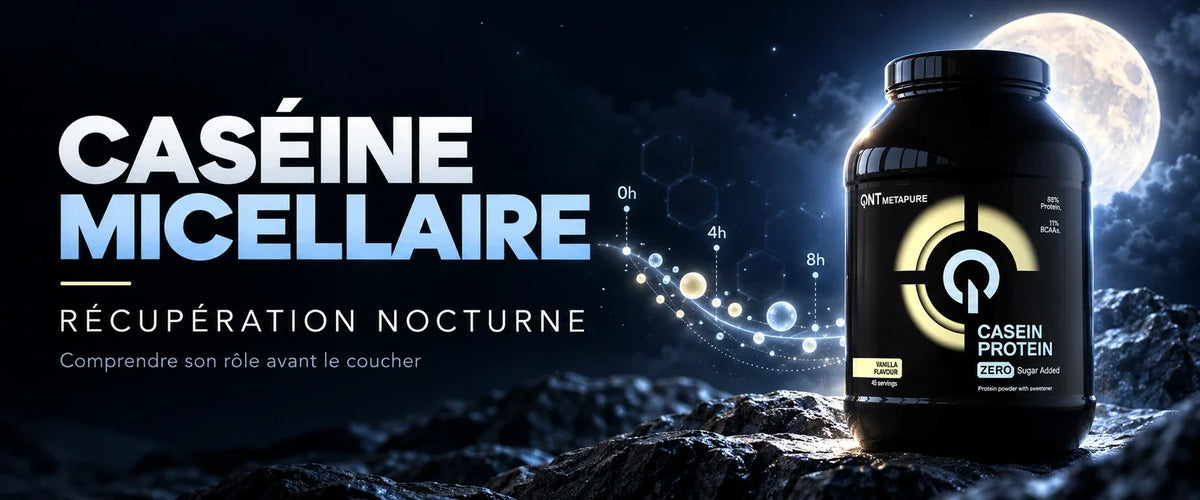
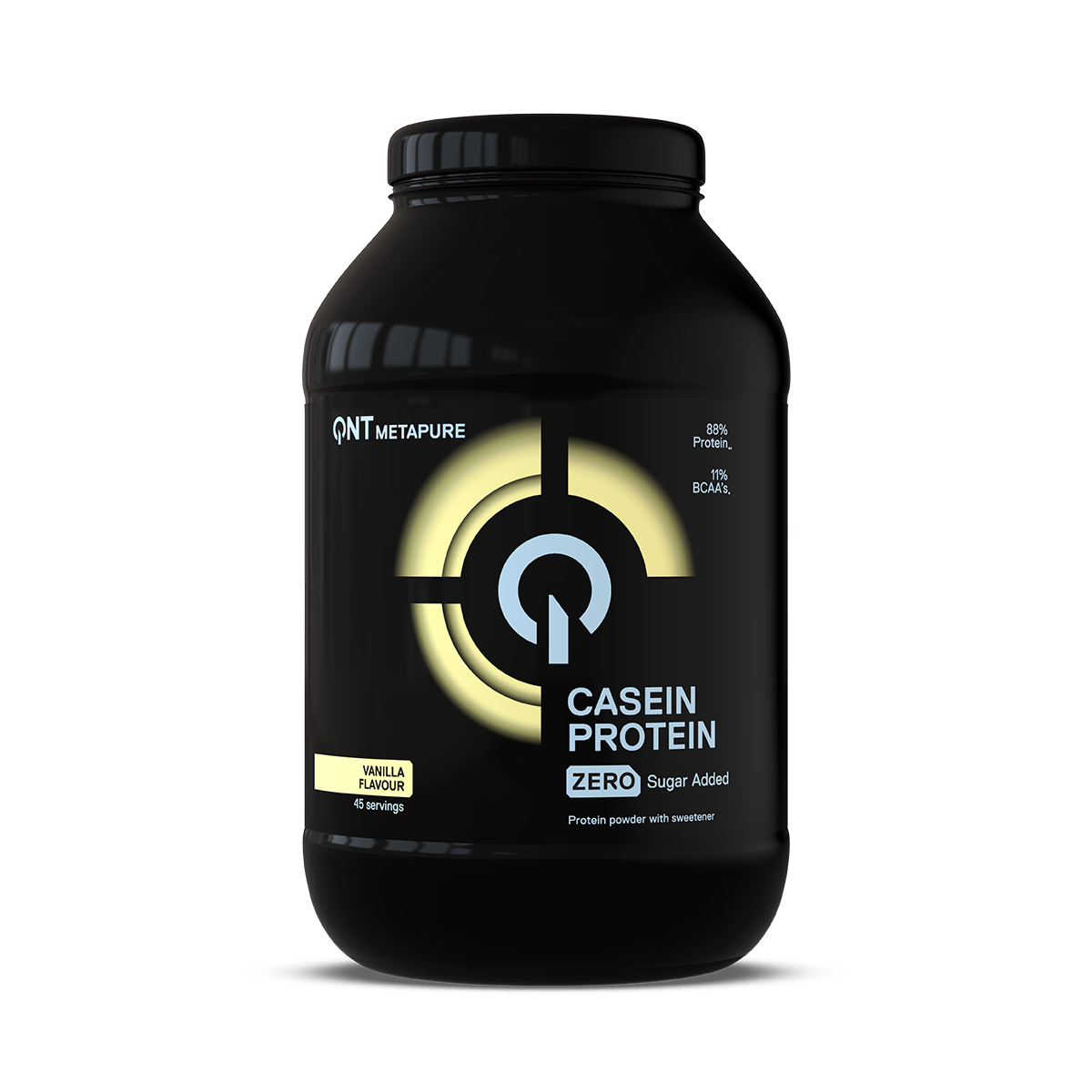
QNT's Casein Protein Micellar combines micellar casein with calcium caseinate, a form of casein that is obtained by acid precipitation instead. Depending on the flavour, it contains 82 to 87% protein with no added sugars.
Why take casein before bed?
Your muscles renew their proteins all the time. They build new ones, a process called protein synthesis, and break down others, a process called protein breakdown (proteolysis). The difference between the two is the protein balance. After a meal that provides protein, the arrival of amino acids tips the balance towards synthesis. Between meals, breakdown takes the upper hand again.
The night is the longest period of fasting in your day. A period of fasting can tip the balance towards a negative protein balance: the muscle then breaks down slightly more protein than it builds. This does not mean that you are losing muscle, though. Over a full day, the gains that follow meals and the losses in between can cancel each other out when your diet covers your needs.
It is this overnight phase that casein taken before bed aims to act on. In the trial by Res et al. (2012), 16 young men did a resistance training session at 8 pm and received 20 g of protein and 60 g of carbohydrates straight afterwards. Thirty minutes before going to sleep, they took either 40 g of casein or a placebo.
Over the night, whole-body protein balance stayed negative with the placebo and became positive with casein. This is the sense in which we can speak of an improvement: during the night, the body built more protein than it broke down, rather than the other way round. The synthesis of muscle protein itself was about 22% higher with casein, a difference at the borderline of statistical significance: we cannot rule out that it was due to chance.

What the research says
Several trials have measured overnight muscle protein synthesis directly, using muscle samples taken during sleep. In 48 men aged 72 on average, taking 40 g of casein before bed increased this synthesis compared with a placebo (Kouw et al., 2017).
The systematic review by Reis et al. (2021) brought together nine studies. It concludes that 20 to 40 g of casein taken about 30 minutes before sleep stimulates protein synthesis during the night in younger and older men alike. The position stand of the International Society of Sports Nutrition (ISSN) on protein and exercise also holds that taking 30 to 40 g of casein before bed increases overnight muscle protein synthesis (Jäger et al., 2017).
The trials cited here that measured this synthesis during the night were all carried out in men. Data in women remain very limited, which does not mean that the effect is different, only that it has not yet been measured in the same way.
More muscle over several weeks?
Higher synthesis over one night does not on its own guarantee more muscle a few months later. In a 12-week resistance training trial in 44 young men, those who took 27.5 g of protein every evening gained more strength and more muscle size than those who received a placebo with no calories (Snijders et al., 2015). However, only the first group received this supplement, so their total protein intake was also higher. The review by Reis et al. (2021) highlights this limitation: the effect of timing cannot be separated from the effect of quantity.
When total intake is the same, the timing of the serving seems to matter much less. In a small 10-week trial, 13 men who took 35 g of casein either during the day or just before bed made the same progress in strength and muscle size (Joy et al., 2018). In older men who train, two 12-week trials found no additional gain whether the protein was taken after the session and before bed (Holwerda et al., 2018) or before bed only (Klemp et al., 2025).
This is why the main benefit of a serving before bed probably lies in the amount more than in the timing. Adding a protein source before sleep could help increase your daily protein intake. The ISSN recommends 1.4 to 2.0 g of protein per kilogram of body weight per day for physically active people, which comes to 105 to 150 g for someone weighing 75 kg (Jäger et al., 2017). Its position stand on nutrient timing makes this total daily intake the priority (Kerksick et al., 2017). Beyond about 1.6 g per kilogram per day, the gains in muscle mass from resistance training no longer increase measurably (Morton et al., 2018).
The ISSN position stand on protein also points out that you can meet these needs through food alone, with supplements mainly offering a practical way to get there (Jäger et al., 2017). Evening casein can therefore be useful when you had dinner early, when your day was low in protein or when part of your target has not yet been met. Quark or skyr, which are both naturally rich in casein, can play the same role.
And recovery the next day?
The protein synthesis measured during the night is a biological mechanism, not a direct measure of recovery. Trials that measured recovery itself, such as strength, jump performance or muscle soreness over the following days, found no advantage for evening protein. In 39 active men and women, about 40 g of casein before bed neither sped up the return of strength nor reduced muscle soreness after a jumping session performed in the morning (Apweiler et al., 2018). In 122 British Army recruits, 20 or 60 g of protein taken on weekday evenings for 12 weeks improved neither performance nor body composition nor recovery (Chapman et al., 2023).
In other words, evening casein supports the renewal of muscle protein during the night, but studies have not so far shown that you recover any faster the next day.
Casein vs whey: which protein should you choose?
The question is not which one to choose over the other, but when each one is most practical. For the same amount of essential amino acids, whey stimulates muscle protein synthesis more than casein in the hours after intake, both at rest and after a session (Tang et al., 2009). In this trial of 18 young men, soy protein isolate also did better than casein. This difference is thought to come from the faster digestion of whey and from its content of leucine, an amino acid that plays a key role in triggering synthesis.
Casein works differently. Its slow digestion mainly helps limit protein breakdown, and it does so over a longer period. In the study by Boirie et al. (1997) mentioned earlier, whole-body protein breakdown fell by 34% after casein and did not change after whey. The first trial to compare the two proteins directly before bed tested 45 g of each in 36 young men after an endurance session. It found no difference in overnight muscle protein synthesis (Trommelen et al., 2023).
| Criterion | Micellar casein (Casein Protein Micellar, vanilla flavour) | Whey isolate (Metapure Whey Isolate Zero, Belgian chocolate flavour) |
|---|---|---|
| Amino acids in the blood after intake | Moderate, prolonged rise | Sharp, brief rise |
| Protein per 100 g of powder | 87.6 g | 77.4 g |
| Sugars per 100 g of powder | 1.05 g | 1.1 g |
| Energy per 100 g of powder | 370 kcal | 360 kcal |
| Serving size on the label | 20 g | 25 g |
The first row describes how each type of protein behaves in the body, based on the study by Boirie et al. (1997). The following rows come from the labels of the two QNT products and are given per 100 g of powder, so you can compare them directly. These values vary slightly depending on the flavour. The casein shows a slightly higher protein content, and both powders provide very little sugar for a similar amount of energy. What mainly sets them apart is the speed at which they release their amino acids, and this is therefore the criterion that can guide when to take each one.
In practice, Metapure Whey Isolate Zero naturally finds its place after training, while Casein Protein Micellar can be used in the evening, when dinner is already well behind you or was low in protein. This split is a matter of convenience rather than an obligation. To learn more about whey timing, you can read our guide Best time to take whey protein.
What dose, and when?
Trials on evening protein have most often used 30 to 40 g of casein taken about 30 minutes before bed (Res et al., 2012; Kouw et al., 2017; Trommelen et al., 2018).
The dose seems to matter. Among the older men in the trial by Kouw et al. (2017), 20 g was not enough even when enriched with leucine, whereas 40 g increased overnight muscle protein synthesis. In 36 young men who had trained in the evening, 30 g improved overnight protein balance without increasing muscle protein synthesis itself (Trommelen et al., 2018). The 40 g dose is therefore the best supported. It is expressed in grams of protein, not in grams of powder.
For someone weighing 75 kg, a 40 g dose is a little over 0.5 g of protein per kilogram of body weight. That is roughly double the usual benchmark for a serving during the day, which the ISSN sets at 0.25 g per kilogram (Jäger et al., 2017).
In practice, a 20 g scoop of Casein Protein Micellar in the vanilla flavour provides 17.5 g of protein. Two scoops provide 35 g, which falls within the range used in the trials. This is also the maximum advised by the manufacturer, which recommends one to two servings per day. Mixed with 250 ml of milk rather than water, the two scoops provide about 8 g of extra protein. The 30-minute gap comes from the study protocols and is not a proven requirement: it seems reasonable to take this serving during the evening, after your last meal.
How to prepare it
Micellar casein naturally has a dense texture. The manufacturer recommends mixing a 20 g scoop with about 250 ml of water or milk, which gives a thick, substantial shake. With milk, the result is closer to a dessert. With less liquid and some time in the fridge, the mixture takes on the consistency of a cream you can eat with a spoon, topped with fruit for example.
How do you fit casein into your evening?
This is not a protocol, only a few pointers to help you plan your evening based on what the studies show.
Training evenings are when a serving before bed is most likely to be useful. In 24 young men who all took 30 g of casein before sleep, overnight muscle protein synthesis was 37% higher in those who had done a resistance training session that evening (Trommelen et al., 2016). Exercise increases the share of amino acids that the muscle actually puts to use during the night.
A serving after your session and another one before bed can go together, as in the trial by Res et al. (2012) described above. Dinner nevertheless remains the main source of protein in your evening: if it already contains a good amount of protein and you ate it late, an extra serving becomes less useful.
Finally, the benefit of casein concerns your muscles rather than your sleep. For sleep itself, our article on magnesium bisglycinate and sleep reviews what the science says.
Who benefits most from micellar casein?
People who do resistance training late in the day are those for whom the evidence is most plentiful, since most of the trials were carried out in this situation.
In older adults, evening casein increases overnight muscle protein synthesis, but it has not provided any additional gain over several months in men who were already eating enough protein. Its value then lies mainly in the chance it offers to raise an intake that falls short. In 12 people with an average age of 71, a drink containing 40 g of casein taken at bedtime reduced neither appetite nor intake at the following breakfast (Morehen et al., 2019).
Athletes in a cutting phase have higher protein needs. According to the ISSN, 2.3 to 3.1 g per kilogram per day may be needed to best preserve lean mass in resistance-trained people who are in a calorie deficit (Jäger et al., 2017). An evening serving is one way among others to reach this level, although to our knowledge no trial has tested it in this specific situation.
For endurance athletes, the trial by Trommelen et al. (2023) mentioned earlier shows that evening protein also increases overnight muscle protein synthesis after exercise. This includes protein synthesis in the mitochondria, the structures that produce energy in muscle cells. However, 40 g of casein before bed improved neither recovery nor performance in 24 professional cyclists at a training camp, who were already eating more than 2.5 g of protein per kilogram per day (Valenzuela et al., 2023).
Vegetarians who eat dairy products may find it a convenient source of milk protein. If you do not eat dairy, our guide to the best plant-based protein sources presents some alternatives.
To see how casein fits into your overall choice of protein, you can read our guide to choosing your protein.
Side effects and safety
Casein is a dietary protein that is found naturally in milk and dairy products. At the amounts described in this guide, the precautions mainly concern three situations.
A large serving taken in the evening can sit heavily on the stomach for some people. In that case, it seems reasonable to start with one scoop and to increase gradually if you tolerate it well.
Casein should be avoided if you have a cow's milk protein allergy, which is a reaction of the immune system to the proteins themselves. This is a different situation from lactose intolerance, which concerns the sugar in milk and depends on the amount consumed.
The processes used to make casein remove most of the lactose. On the Casein Protein Micellar label, the "of which sugars" line shows 1.05 g per 100 g. This line includes lactose, so a 20 g scoop provides at most 0.21 g of it. Most people with lactose intolerance can handle up to 12 g in one go with few or no symptoms, although tolerance varies from one person to another (EFSA, 2010).
If you prepare the drink with milk, however, it also provides the lactose contained in the milk itself, which you can avoid by using water or a lactose-free drink instead. If in doubt, the best option is still to ask your doctor for advice.
In summary
Micellar casein is digested slowly and releases its amino acids over several hours, which makes it a protein particularly well suited to the evening. Taken before bed, it improves overnight protein balance and, at 40 g, increases muscle protein synthesis during sleep. Over several weeks, its value lies mainly in the protein it adds to your day, and studies do not show faster recovery the next day. It therefore has its place on training evenings or when your diet fell short during the day, alongside a dinner that remains your main source of protein.
Sources
- Apweiler, E. et al. (2018). Pre-Bed Casein Protein Supplementation Does Not Enhance Acute Functional Recovery in Physically Active Males and Females When Exercise is Performed in the Morning. Sports, 7(1), 5. https://doi.org/10.3390/sports7010005
- Boirie, Y. et al. (1997). Slow and fast dietary proteins differently modulate postprandial protein accretion. Proceedings of the National Academy of Sciences, 94(26), 14930-14935. https://doi.org/10.1073/pnas.94.26.14930
- Chapman, S. et al. (2023). Pre-sleep protein supplementation does not improve performance, body composition, and recovery in British Army recruits (part 1). Frontiers in Nutrition, 10, 1262044. https://doi.org/10.3389/fnut.2023.1262044
- Dela Cruz, J. & Kahan, D. (2021). Pre-Sleep Casein Supplementation, Metabolism, and Appetite: A Systematic Review. Nutrients, 13(6), 1872. https://doi.org/10.3390/nu13061872
- EFSA Panel on Dietetic Products, Nutrition and Allergies (2010). Scientific Opinion on lactose thresholds in lactose intolerance and galactosaemia. EFSA Journal, 8(9), 1777. https://doi.org/10.2903/j.efsa.2010.1777
- Holwerda, A.M. et al. (2018). Protein Supplementation after Exercise and before Sleep Does Not Further Augment Muscle Mass and Strength Gains during Resistance Exercise Training in Active Older Men. The Journal of Nutrition, 148(11), 1723-1732. https://doi.org/10.1093/jn/nxy169
- Jäger, R. et al. (2017). International Society of Sports Nutrition Position Stand: protein and exercise. Journal of the International Society of Sports Nutrition, 14, 20. https://doi.org/10.1186/s12970-017-0177-8
- Joy, J.M. et al. (2018). Daytime and nighttime casein supplements similarly increase muscle size and strength in response to resistance training earlier in the day: a preliminary investigation. Journal of the International Society of Sports Nutrition, 15(1), 24. https://doi.org/10.1186/s12970-018-0228-9
- Kerksick, C.M. et al. (2017). International Society of Sports Nutrition Position Stand: nutrient timing. Journal of the International Society of Sports Nutrition, 14, 33. https://doi.org/10.1186/s12970-017-0189-4
- Klemp, A.O. et al. (2025). Neither pre-sleep nor post-exercise protein consumption influences resistance exercise training adaptations in older adults. Journal of the International Society of Sports Nutrition, 22(1), 2519511. https://doi.org/10.1080/15502783.2025.2519511
- Kouw, I.W. et al. (2017). Protein Ingestion before Sleep Increases Overnight Muscle Protein Synthesis Rates in Healthy Older Men: A Randomized Controlled Trial. The Journal of Nutrition, 147(12), 2252-2261. https://doi.org/10.3945/jn.117.254532
- Morehen, S. et al. (2019). Pre-Sleep Casein Protein Ingestion Does Not Impact Next-Day Appetite, Energy Intake and Metabolism in Older Individuals. Nutrients, 12(1), 90. https://doi.org/10.3390/nu12010090
- Morton, R.W. et al. (2018). A systematic review, meta-analysis and meta-regression of the effect of protein supplementation on resistance training-induced gains in muscle mass and strength in healthy adults. British Journal of Sports Medicine, 52(6), 376-384. https://doi.org/10.1136/bjsports-2017-097608
- Reis, C.E.G. et al. (2021). Effects of pre-sleep protein consumption on muscle-related outcomes: a systematic review. Journal of Science and Medicine in Sport, 24(2), 177-182. https://doi.org/10.1016/j.jsams.2020.07.016
- Res, P.T. et al. (2012). Protein ingestion before sleep improves postexercise overnight recovery. Medicine & Science in Sports & Exercise, 44(8), 1560-1569. https://doi.org/10.1249/MSS.0b013e31824cc363
- Snijders, T. et al. (2015). Protein Ingestion before Sleep Increases Muscle Mass and Strength Gains during Prolonged Resistance-Type Exercise Training in Healthy Young Men. The Journal of Nutrition, 145(6), 1178-1184. https://doi.org/10.3945/jn.114.208371
- Tang, J.E. et al. (2009). Ingestion of whey hydrolysate, casein, or soy protein isolate: effects on mixed muscle protein synthesis at rest and following resistance exercise in young men. Journal of Applied Physiology, 107(3), 987-992. https://doi.org/10.1152/japplphysiol.00076.2009
- Trommelen, J. et al. (2016). Resistance Exercise Augments Postprandial Overnight Muscle Protein Synthesis Rates. Medicine & Science in Sports & Exercise, 48(12), 2517-2525. https://doi.org/10.1249/MSS.0000000000001045
- Trommelen, J. et al. (2018). Presleep dietary protein-derived amino acids are incorporated in myofibrillar protein during postexercise overnight recovery. American Journal of Physiology-Endocrinology and Metabolism, 314(5), E457-E467. https://doi.org/10.1152/ajpendo.00273.2016
- Trommelen, J. et al. (2023). Pre-sleep Protein Ingestion Increases Mitochondrial Protein Synthesis Rates During Overnight Recovery from Endurance Exercise: A Randomized Controlled Trial. Sports Medicine, 53(7), 1445-1455. https://doi.org/10.1007/s40279-023-01822-3
- Valenzuela, P.L. et al. (2023). Pre-sleep protein supplementation in professional cyclists during a training camp: a three-arm randomized controlled trial. Journal of the International Society of Sports Nutrition, 20(1), 2166366. https://doi.org/10.1080/15502783.2023.2166366
Updated September 14, 2026
By Marius Grek, nutrition expert at QNT Sport, which has been manufacturing food supplements since 1992.
Frequently asked questions
What is micellar casein?
When should you take micellar casein?
Casein or whey: what is the difference?
How much casein should you take before bed?
Does casein make you gain weight?
Is casein suitable if you are lactose intolerant?
Can you mix casein and whey?
Keep reading
 Gain Muscle
How to Choose Protein Powder: The Ultimate 2026 Guide
Whey, isolate, casein or vegan? Learn how to choose protein powder for your goal, with a comparison table, the amino acid profile that actually mat...

Best time to take whey protein: the complete science-backed guide
When should you take whey protein? Morning, post-workout or before bed: discover the optimal timing backed by 6 studies. Expert guide by QNT Sport.
 Well-Being
Glutamine benefits, dosage and muscle recovery: complete guide 2026
What does glutamine actually do? What studies say, optimal dosing by goal, and practical recovery tips. Science-backed guide by QNT Sport, Belgian ...
 Gain Muscle
Mass gainer: what it does and how to use it for muscle gain
How to use a mass gainer: what it does, how many scoops a day, when to take it and how it differs from whey, so the weight you gain is mostly muscle.


