





Protein Drinks: How to Choose Between Water, Shake and Powder
Table of Content
- Which protein should you choose for a protein drink?
- How much protein is there in a protein drink?
- Also look at the sugars and the calories
- Protein water, shake or powder: which format should you choose?
- Which protein drink after sport?
- Which protein drink for bulking?
- How do you choose your protein drink properly?
- Protein water, protein shake or powder: what are the differences?
- What are the benefits of a protein drink?
- When should you drink your protein drink?
- How much protein should you aim for per serving?
- Sugars, calories, lactose: what to check on the label
- Ready to drink or powder: the right choice for your use
- Conclusion
- Sources

A protein drink is an easy way to raise your daily protein intake. It can be sold ready to drink, in a bottle or a carton, or made at home from a powder. But between protein waters, shakes and gainers, it is not always easy to know which product to pick.
To find the best protein drink for your needs, three criteria already narrow the field: the source and the amount of protein, the sugar and calorie content, and the moment you are going to drink it.
Which protein should you choose for a protein drink?
Whey is the protein most commonly used in protein drinks. It comes from milk, it is digested quickly, and it is therefore a practical option around training, particularly after a session.
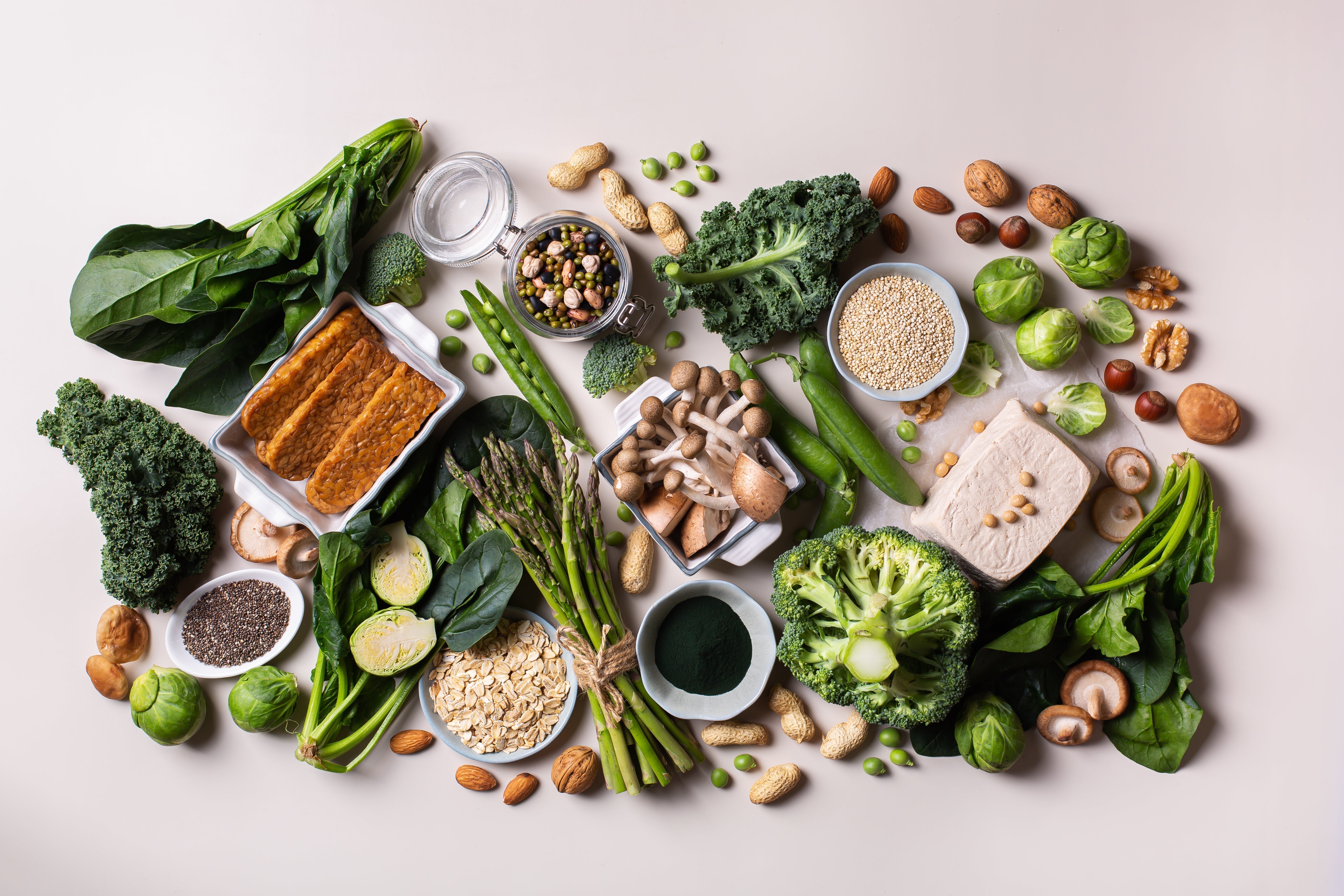
Casein, which also comes from milk, is digested more slowly. It releases its amino acids gradually over several hours. Plant proteins, such as pea, rice or soy, are another option, particularly for people who do not eat dairy products.
Whey or casein: what are the differences?
The quality of a protein does not depend only on the amount printed on the label. You also need to look at its amino acid profile and at how fast it is digested and absorbed.
Whey becomes available quickly after you drink it, while casein supplies its amino acids more gradually. The first is sometimes described as « anabolic » and the second as « anti-catabolic ». These terms are simplifications, though: they mainly describe differences in digestive kinetics and in amino acid availability, rather than two fundamentally opposite effects.
How much protein is there in a protein drink?
The point of a protein drink is above all to top up your diet when food alone does not easily cover your protein needs.
Those needs vary with body weight, activity level and goals. As a benchmark, a sedentary adult needs around 0.8 g of protein per kilo of body weight per day. For someone who trains regularly, needs can be higher, in the region of 1.4 to 2.0 g/kg/day, depending on the type of training and the goals being pursued (Jäger et al., 2017).
So there is no particular reason to pick the drink that contains the most protein. What matters is looking at the amount supplied per serving and putting it in perspective against your total daily intake.
Also look at the sugars and the calories
Two drinks with a similar amount of protein can have very different nutritional profiles. The carbohydrate, fat and calorie content depends in particular on how the product is formulated.
A protein water generally supplies mostly protein and few extra calories. A ready to drink protein shake can contain more carbohydrate or fat depending on its recipe.
The gainer follows a different logic. Aimed in particular at people looking to make bulking easier, it combines protein with a large amount of carbohydrate in order to raise daily energy intake more easily.
Before choosing a protein drink, it is therefore worth looking at the whole nutrition panel rather than focusing only on the number of grams of protein.
Protein water, shake or powder: which format should you choose?

The protein drink market has grown considerably. Today you will find protein waters, ready to drink shakes and protein powders to make up yourself. Some products supply around twenty grams of protein per serving, while others display more than 50 g per bottle.
The format depends above all on your habits and your routine.
The ready to drink protein drink
This is the simplest option when you are short on time. No shaker and no preparation: you can easily take it to the gym, to work or on the road.
Protein water
Lighter and generally lower in calories than a traditional shake, protein water can be worth considering if your goal is to raise your protein intake without adding many calories.
Protein powder
Powder offers more flexibility. You can adjust the amount you use, choose the liquid you mix it with and adapt your intake more easily to your needs. In return, it takes a little more preparation.
Which protein drink after sport?
A protein drink can be practical after training, particularly when you are not planning a meal soon or when your diet is not enough to cover your protein needs.
Whey is often preferred in this context because it is digested quickly. But the choice of product should not rest on timing alone: total protein intake across the day remains an essential element.
In other words, there is no need to systematically look for a specific drink to have immediately after every session. The right product is above all the one that fits easily into your diet and helps you reach your goals.
Which protein drink for bulking?
For bulking, energy needs go up. A classic protein drink can be enough if you are simply looking to top up your protein intake. If you also struggle to eat enough calories, a gainer, richer in carbohydrate, can be a practical solution.
Conversely, if your goal is to control your calorie intake while keeping a sufficient protein intake, a protein water or a low calorie drink can suit you better.
The choice therefore depends as much on your goal as on your diet as a whole.
How do you choose your protein drink properly?
To compare two products, take a few seconds to read their labels. In particular, check:
- the protein source: whey, casein or plant proteins;
- the amount of protein per serving;
- the sugar and carbohydrate content;
- the total number of calories;
- the amount of fat;
- and, above all, how well these values line up with your goal.
Format counts too. A ready to drink product can be ideal when time is short, while a powder generally gives you better control over the amounts.
So which is the best protein drink?
There is no single best protein drink that works for everyone. The right choice depends on your goal, your sport, your nutritional needs and your daily life.
For a quick snack after sport, a ready to drink whey can be particularly practical. For bulking that calls for more calories, a gainer can have its place. To raise your protein intake without adding many calories, a protein water can be an interesting option. And for anyone looking for flexibility, powder remains a particularly versatile format.
The best product is therefore less the one that displays the most protein than the one whose composition genuinely matches your needs and that you can easily build into your diet.
In the rest of this guide, we compare the three main families of protein drinks (protein waters, ready to drink shakes and powders) to help you choose the format and the protein best suited to your goal, your sport and your habits.
Protein water, protein shake or powder: what are the differences?
The difference between these three families of products rests mainly on three figures: the amount of protein per serving, the sugar content and the energy value. These are the first pieces of information to compare on a label and, in most cases, they are enough to separate two products.
The table below compares five products from the QNT range, ranked from the lowest to the highest in calories.
| Format | Protein per serving | Sugars per serving | Energy value |
|---|---|---|---|
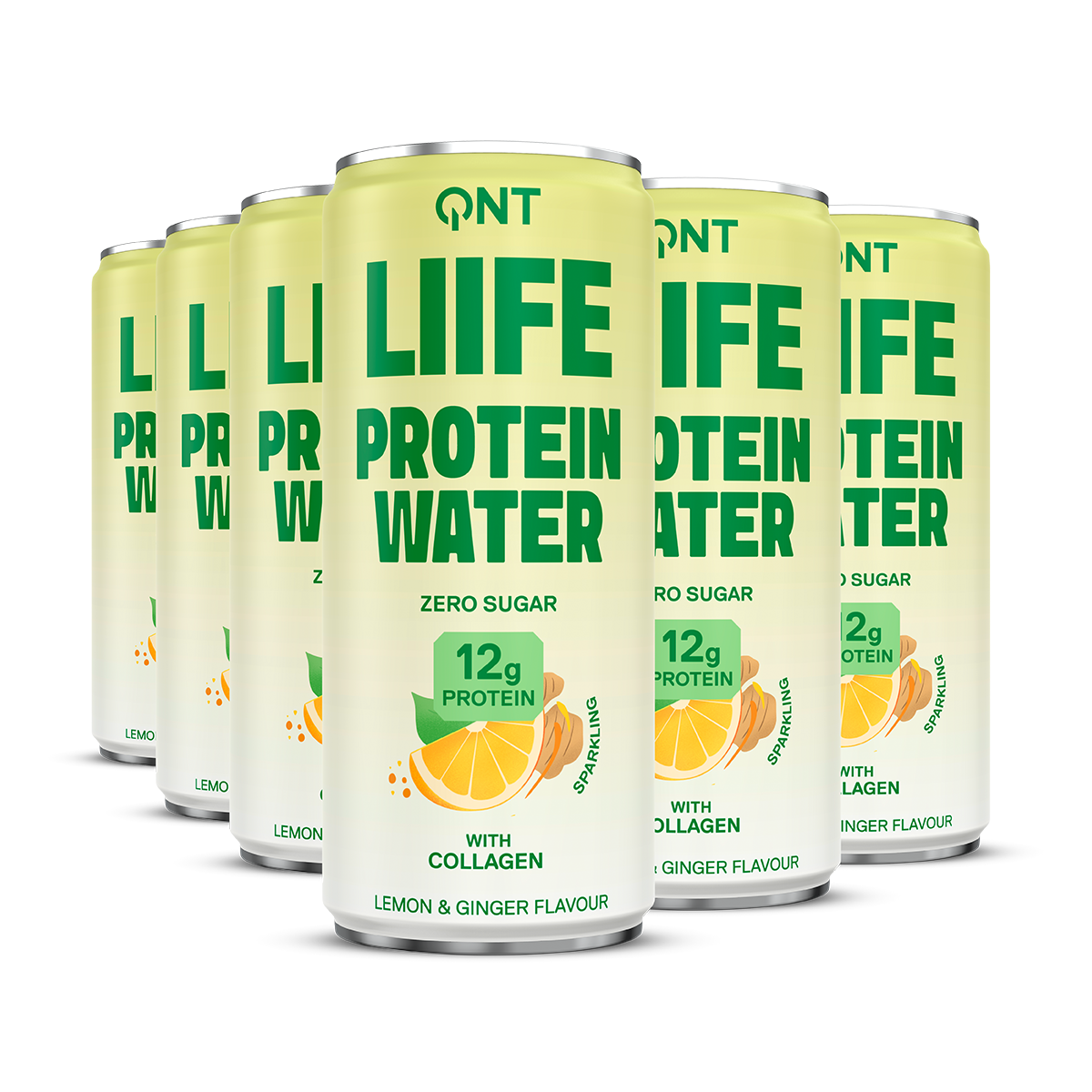
| Protein Water, 330 ml can | 12 g | 0 g | 56 kcal |
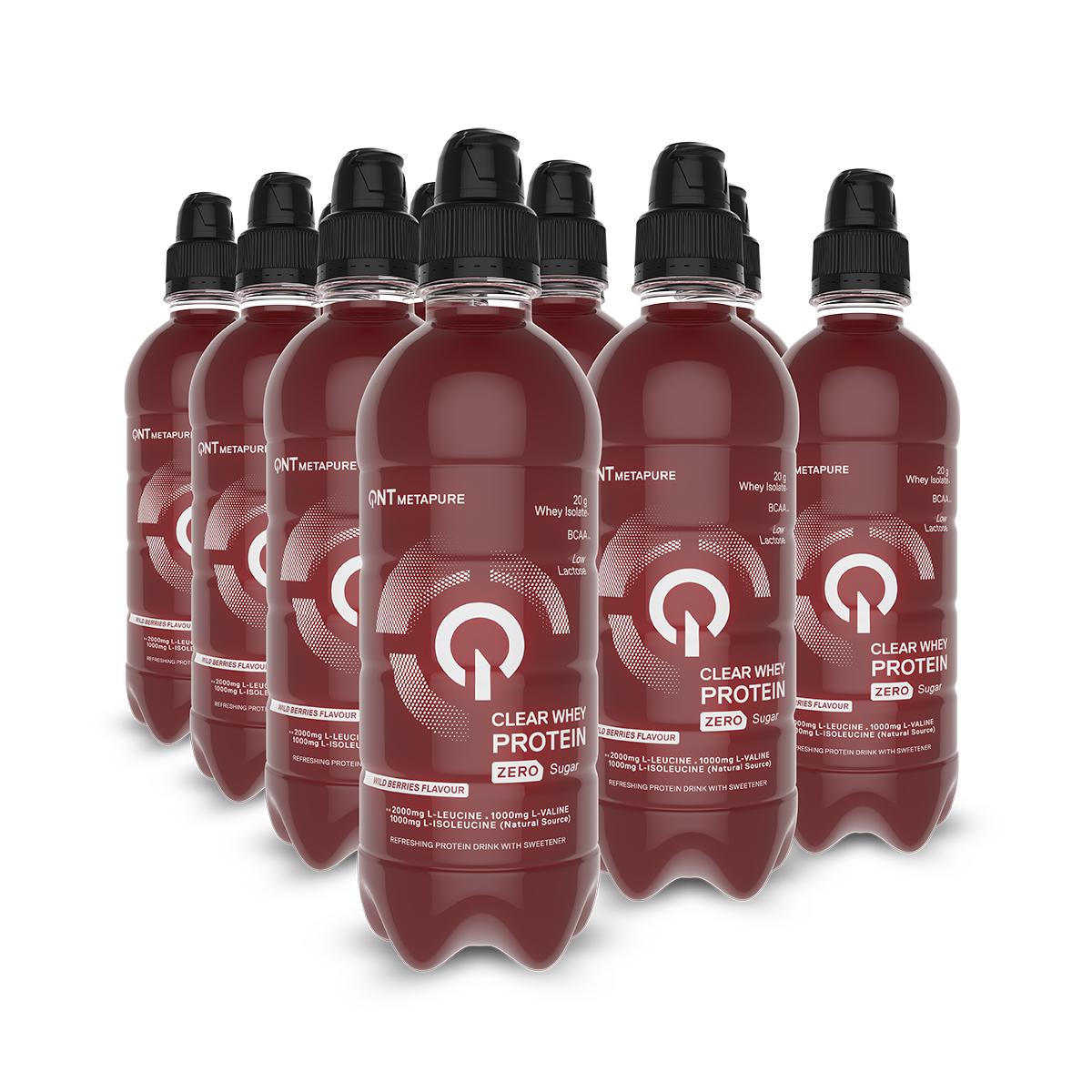
| Iso Whey Zero Carb Protein Water, 500 ml bottle | 20 g | less than 0.5 g | 70 kcal |
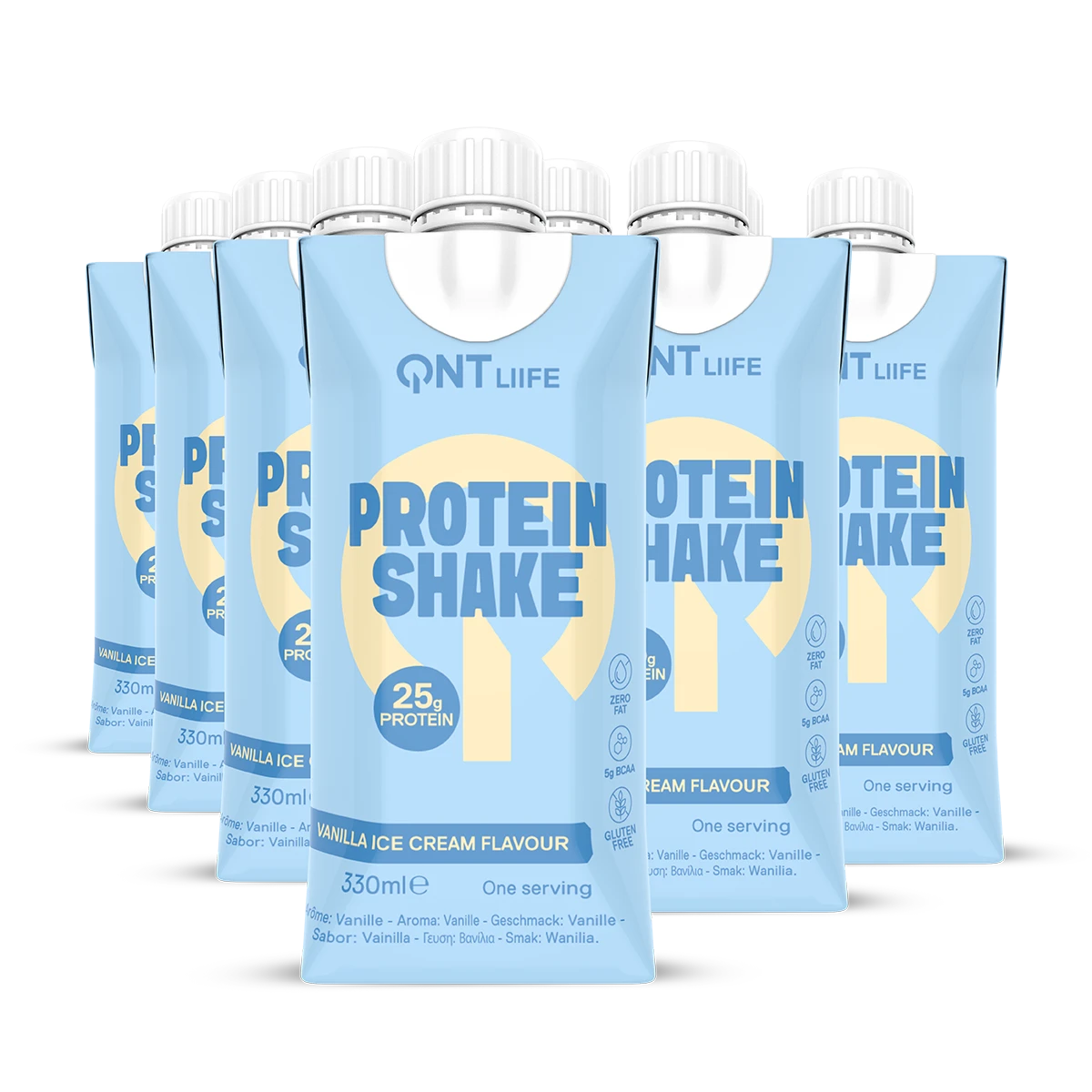
| Protein Shake, 330 ml carton | 25 g | 16.8 g | 217 kcal |
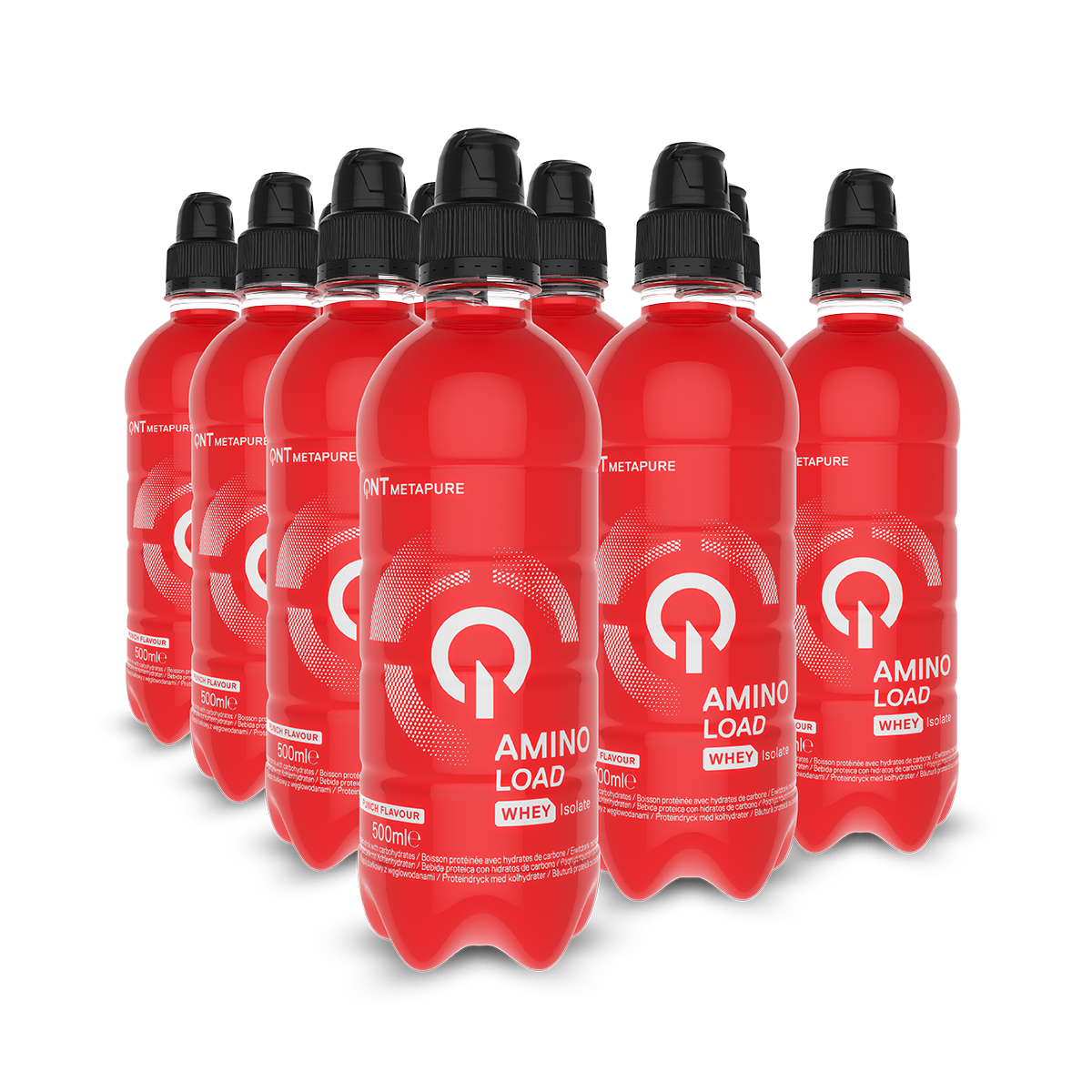
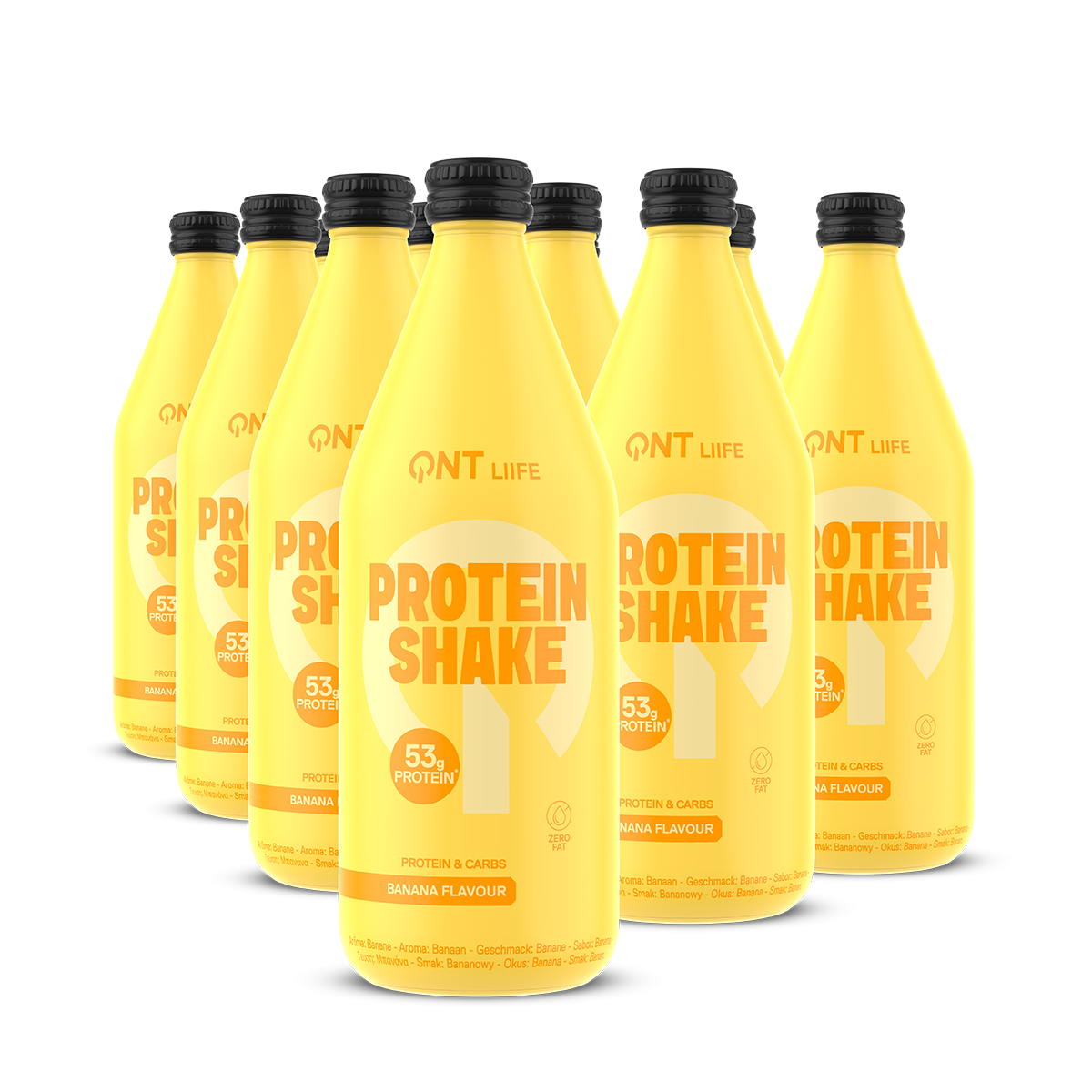
| Protein Shake Glass Bottle, 500 ml bottle | 53 g | 54 g | 435 kcal |
| Prime Whey Protein, 30 g serving | 21 g | 2 g | 107 kcal |
Protein water: lightness first
A protein water is a clear drink generally formulated from whey isolate, often sold under the name clear whey. Unlike a classic shake, it does not try to reproduce a milky texture: the result is a light, transparent drink, closer to a refreshing beverage.
The formulation of clear whey products relies in particular on filtration and protein processing steps that produce a clear drink, with a reduced fat and lactose content depending on the product.
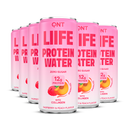
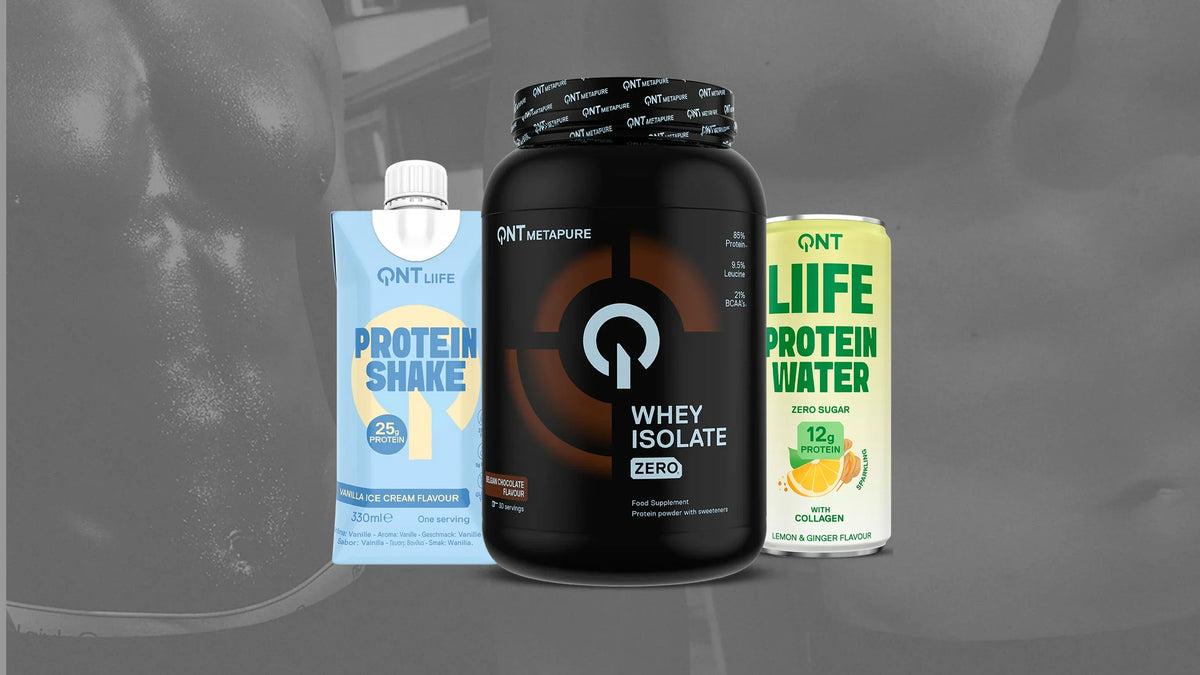
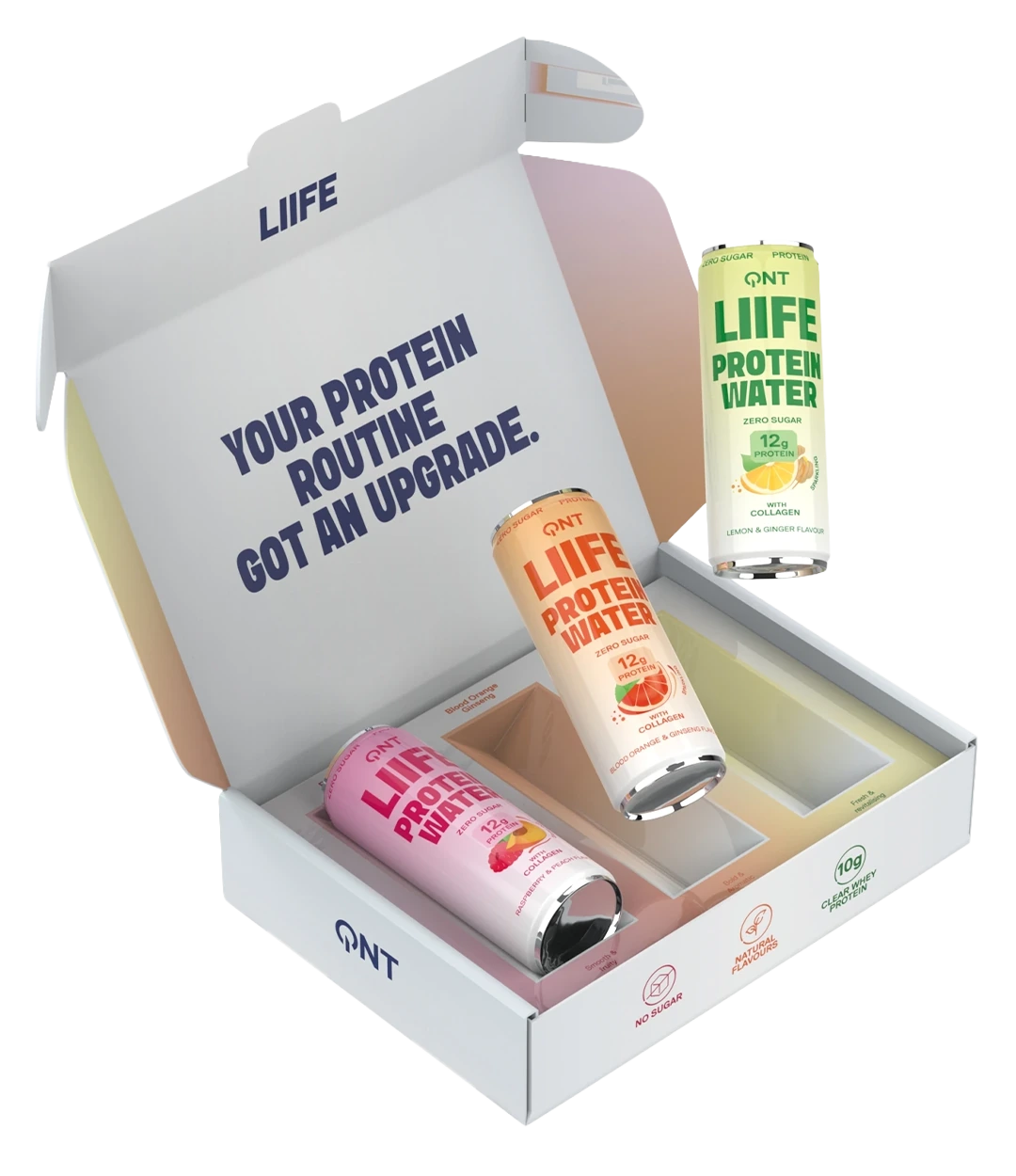
The QNT Protein Water from the LIIFE range supplies 12 g of protein and collagen per sparkling 330 ml can, with no sugars. To raise the amount of protein per serving, Iso Whey Zero Carb Protein Water supplies 20 g of whey isolate per 500 ml bottle, with no added sugars.
This format can suit athletes who prefer a light drink after training, or who are not keen on the thick, milky textures of traditional shakes.
The protein shake: a ready to drink protein snack
The ready to drink protein shake answers a different need: supplying a large amount of protein in a directly drinkable format. Its creamy texture and its nutritional profile place it closer to a snack than to a thirst quencher.
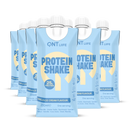
The QNT Protein Shake supplies 25 g of protein per 330 ml carton. The Protein Shake Glass Bottle, in its 500 ml format, climbs to 53 g of protein, for people who need a higher intake.
Its main advantage is convenience: it can be drunk straight after a session, at work or while travelling, with no preparation and no shaker.
These formats do also supply carbohydrate and sugars, though. They should therefore be treated as a genuine snack within the balance of your day, and not necessarily as an addition to a snack you had already planned. The 500 ml format on its own represents a large share of the reference intake for sugars, set at 90 g per day.
What are the benefits of a protein drink?
The main value of a protein drink is simple: it makes it easy to raise your daily protein intake without having to prepare a specific meal or snack.
Protein contributes in particular to maintaining and building muscle mass. This effect does not depend on the protein being consumed as a drink: dairy proteins and plant proteins alike can contribute to that intake when they are eaten as part of a suitable diet.
Among people who take regular physical exercise, protein needs are generally higher than those of a sedentary person. The International Society of Sports Nutrition recommends a daily intake of 1.4 to 2.0 g of protein per kilo of body weight for people who train regularly (Jäger et al., 2017).
For a 75 kg person, that works out at roughly 105 to 150 g of protein per day. These values are benchmarks, though: needs vary in particular with the type of physical activity, the training volume and the goal being pursued.
The available data further suggest that beyond around 1.6 g/kg/day, raising protein intake further does not necessarily bring a notable extra benefit for muscle mass gains in most people doing strength training (Morton et al., 2018).
A practical solution above all
The value of a protein drink therefore lies less in any particular effect tied to the liquid format than in its convenience. The recommendations concern total protein intake across the day, not the need to drink a protein drink at a precise moment.
A drink that is easy to carry, pleasant to drink and available when you need it can help you reach your nutritional goals more consistently.
Protein water has one further particularity: it combines a protein intake with a fluid intake. Its format can therefore be interesting after physical effort, particularly when you also need to rehydrate after sweating.
In summary: protein water plays on lightness, the protein shake on convenience and protein content, while powder offers more flexibility in dosing. The choice therefore depends above all on your needs, your goal and the place you want to give this drink in your diet.
When should you drink your protein drink?
The best time to drink a protein drink is above all the one that fits naturally into your daily diet. What counts most is the total amount of protein you take in over the day, rather than sticking to a precise hour.
According to the ISSN position stand on nutrient timing, the window around training is in fact wider than was long assumed: protein intake can be useful for several hours before or after the session (Kerksick et al., 2017).
In practice, three moments stand out: after training, when the next meal is still some way off, as an afternoon snack to top up your intake, or while travelling, when access to a sufficiently protein-rich meal is limited.
A protein drink can also be drunk on rest days. Protein needs do not disappear when you are not training: recovery and the maintenance of muscle mass carry on then too. For a closer look at when to take a whey powder and how to optimise its timing, read our guide on when to take whey protein.
How much protein should you aim for per serving?
For most athletes, a serving supplying 20 to 30 g of protein is a good benchmark. The next step is to spread that intake across the day, usually over 3 to 4 servings a few hours apart. This approach draws in particular on the ISSN recommendations, which suggest spacing protein intake every 3 to 4 hours in order to stimulate muscle protein synthesis regularly (Jäger et al., 2017).
The principle is fairly simple: each protein serving stimulates muscle protein synthesis for several hours, after which the stimulation gradually fades. Leucine, an essential amino acid that plays a key role in triggering this process, is present in large amounts in dairy proteins in particular. A serving of around 20 to 30 g of quality protein can therefore supply a significant amount of leucine (Jäger et al., 2017).
In practice, the amount to favour also depends on the format you choose. A can of protein water can be a useful complement to a light meal or a snack, while a 500 ml bottle or a shake serving comes closer to a full protein serving. Larger formats, for their part, can suit people with higher protein needs or days when a full meal is not possible.
There is no need, however, to systematically look for the highest protein serving. The ISSN recommendations show that a very large amount taken in a single serving does not necessarily mean a proportionally larger stimulation of muscle protein synthesis in most people (Jäger et al., 2017). The most useful approach therefore remains matching the amount you drink to your body weight, your needs and your overall daily diet.
Sugars, calories, lactose: what to check on the label
To compare two protein drinks, three pieces of information deserve particular attention: the amount of sugar, the calorie content and the protein source. The differences can be large, including between products belonging to the same range.
On sugars, a clear protein water can contain very little, while a smoother shake can supply more, depending in particular on its composition. To read the label properly, look above all at the « of which sugars » figure per serving or per unit consumed. The value given per 100 ml can be misleading when the bottle holds several hundred millilitres.
On calories, a protein drink does not make you gain weight on its own. Weight gain depends above all on your overall energy balance over time, meaning the difference between the calories you take in and the calories you burn. In practice it is therefore better to treat your protein drink as a snack to build into your daily diet, rather than as a « free » drink that would automatically add to your usual intake.
Finally, lactose is also worth taking into account if you are sensitive to it. Protein waters formulated from protein isolates can generally have a very low lactose content, while drinks based on milk or protein concentrates can contain more. If your intolerance is confirmed, always check the nutrition information and the ingredient list of the product concerned. If you are looking for a dairy-free alternative, our guide to the best plant-based protein sources covers pea and rice protein blends in particular.
Ready to drink or powder: the right choice for your use
Ready to drink plays above all on convenience, while powder generally remains cheaper. For the same amount of protein, a classic powder often costs less than a liquid format, which also carries the cost of the bottle, the transport and, depending on the product, of preservation. Powder also offers more flexibility: you can set precisely the amount you prepare according to your needs, whereas a ready to drink product comes with a fixed dose.
In practice, the most sensible choice can be to combine the two formats. Powder is perfectly suited to regular use at home, while ready to drink becomes particularly useful when you are travelling, after training, or when you have no shaker and no water to hand.
Still hesitating between whey, casein and plant proteins? Our guide to choosing the right protein compares the different protein families against your goals. To discover our ready to drink options, you will find the full range in our Protein drinks collection, which includes light protein waters as well as smoother shakes. QNT formulates and manufactures its products in Belgium.
Conclusion
Choosing a protein drink means choosing a format suited to your use, rather than relying only on the figure printed on the label. Format counts, but the label remains the best way to know what the drink really delivers: which protein source, how much of it, how much sugar and how many calories.
A protein water supplies protein with little or no sugar and can easily accompany your day or your recovery after effort. A protein shake, creamier and more substantial, is drunk more as a genuine snack and should be counted as one in your diet. Protein powder, finally, lets you adjust amounts precisely and generally remains the cheapest solution.
The right format therefore depends on your goal, your sport and the time you have. Above all, it is the one that lets you top up your daily protein intake consistently, week after week.
You will find the format suited to your needs in the QNT Protein drinks collection, from the lightest protein water to the most substantial shake.
Sources
- Areta, J.L. et al. (2013). Timing and distribution of protein ingestion during prolonged recovery from resistance exercise alters myofibrillar protein synthesis. The Journal of Physiology. https://doi.org/10.1113/jphysiol.2012.244897
- Boirie, Y. et al. (1997). Slow and fast dietary proteins differently modulate postprandial protein accretion. Proceedings of the National Academy of Sciences. https://doi.org/10.1073/pnas.94.26.14930
- EFSA (2010). Scientific Opinion on the substantiation of health claims related to protein and growth or maintenance of muscle mass (ID 415, 417, 593, 594, 595, 715) pursuant to Article 13(1) of Regulation (EC) No 1924/2006. EFSA Journal. https://doi.org/10.2903/j.efsa.2010.1811
- EFSA (2012). Scientific Opinion on Dietary Reference Values for protein. EFSA Journal. https://doi.org/10.2903/j.efsa.2012.2557
- Hall, K.D. et al. (2012). Energy balance and its components: implications for body weight regulation. The American Journal of Clinical Nutrition. https://doi.org/10.3945/ajcn.112.036350
- Jäger, R. et al. (2017). International Society of Sports Nutrition Position Stand: protein and exercise. Journal of the International Society of Sports Nutrition. https://doi.org/10.1186/s12970-017-0177-8
- Kerksick, C.M. et al. (2017). International Society of Sports Nutrition Position Stand: nutrient timing. Journal of the International Society of Sports Nutrition. https://doi.org/10.1186/s12970-017-0189-4
- Macnaughton, L.S. et al. (2016). The response of muscle protein synthesis following whole-body resistance exercise is greater following 40 g than 20 g of ingested whey protein. Physiological Reports. https://doi.org/10.14814/phy2.12893
- Maughan, R.J. et al. (2016). A randomized trial to assess the potential of different beverages to affect hydration status: development of a beverage hydration index. The American Journal of Clinical Nutrition. https://doi.org/10.3945/ajcn.115.114769
- Misselwitz, B. et al. (2019). Update on lactose malabsorption and intolerance: pathogenesis, diagnosis and clinical management. Gut. https://doi.org/10.1136/gutjnl-2019-318404
- Moore, D.R. et al. (2009). Ingested protein dose response of muscle and albumin protein synthesis after resistance exercise in young men. The American Journal of Clinical Nutrition. https://doi.org/10.3945/ajcn.2008.26401
- Morton, R.W. et al. (2018). A systematic review, meta-analysis and meta-regression of the effect of protein supplementation on resistance training-induced gains in muscle mass and strength in healthy adults. British Journal of Sports Medicine. https://doi.org/10.1136/bjsports-2017-097608
- Pinckaers, P.J.M. et al. (2021). The Anabolic Response to Plant-Based Protein Ingestion. Sports Medicine. https://doi.org/10.1007/s40279-021-01540-8
- Tang, J.E. et al. (2009). Ingestion of whey hydrolysate, casein, or soy protein isolate: effects on mixed muscle protein synthesis at rest and following resistance exercise in young men. Journal of Applied Physiology. https://doi.org/10.1152/japplphysiol.00076.2009
- Thomas, D.T. et al. (2016). Position of the Academy of Nutrition and Dietetics, Dietitians of Canada, and the American College of Sports Medicine: Nutrition and Athletic Performance. Journal of the Academy of Nutrition and Dietetics. https://doi.org/10.1016/j.jand.2015.12.006
- Witard, O.C. et al. (2014). Myofibrillar muscle protein synthesis rates subsequent to a meal in response to increasing doses of whey protein at rest and after resistance exercise. The American Journal of Clinical Nutrition. https://doi.org/10.3945/ajcn.112.055517
- Regulation (EU) No 1169/2011 of the European Parliament and of the Council on the provision of food information to consumers, Annex XIII (reference intakes). Official Journal of the European Union. https://eur-lex.europa.eu/eli/reg/2011/1169/oj/eng
- Commission Regulation (EU) No 432/2012 establishing a list of permitted health claims made on foods. Official Journal of the European Union. https://eur-lex.europa.eu/eli/reg/2012/432/oj/eng
- Examine, Whey Protein. https://examine.com/supplements/whey-protein/
Updated September 8, 2026
By Marius Grek, nutrition expert at QNT Sport, which has been manufacturing food supplements since 1992.
FAQ
What is the difference between protein water and a protein shake?
How much protein is in a QNT protein drink?
When should you drink a protein drink: before or after training?
Can you drink a protein drink every day ?
Does a protein drink replace a meal?
Does a ready-to-drink protein drink make you gain weight ?
Do QNT protein waters contain lactose ?
Can you drink a protein drink without doing sport?
Read more
 Gain Muscle
How to Choose Protein Powder: The Ultimate 2026 Guide
Whey, isolate, casein or vegan? Learn how to choose protein powder for your goal, with a comparison table, the amino acid profile that actually mat...

Best time to take whey protein: the complete science-backed guide
When should you take whey protein? Morning, post-workout or before bed — discover the optimal timing backed by 6 studies. Expert guide by QNT Sport.
Best Plant-Based Protein Sources: The Complete Guide for Muscle
What are the best plant-based protein sources for muscle? Foods, DIAAS scores, dosing and the pea + rice blend, explained by science. Guide by QNT ...
 Coach’s Tips
Protein for women: how much do you need, what are the benefits and how do you choose your whey?
How much protein do women really need? Evidence-based daily targets by age and activity level, what the studies show, and how to choose the right w...


