
















Periodizing your nutrition: supplements and recovery for elite sprinters. An interview with Lucas Mathonat
Table of contents
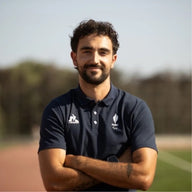
Interview conducted by Marius Grek, nutrition expert at QNT Sport.
Quotes have been translated from French.
In short. For elite sprinters, it makes more sense to plan supplementation around the training calendar than to treat it as a routine you set once and never revisit.
When it comes to supplements, people almost always ask the question the wrong way round: they ask which ones to take, rarely when to take them, and never when to do without. That framing assumes supplementation is something fixed, a routine you set up once and keep going for as long as you train. But training is anything but fixed. It moves through heavy-load phases, tapers, return-to-training periods and competition weeks, and their demands have little in common. So why should your intake stay the same from the start of the season to the end?
The idea is now well established in the scientific literature, where it is known as nutritional periodization: rather than being applied the same way all year, nutrition can be adjusted to your goals, your level and the demands of training as the cycle unfolds (Jeukendrup, 2017). The open question is what this looks like on the ground, in the daily life of a training group where everyone buys their own products and organizes their days as best they can.
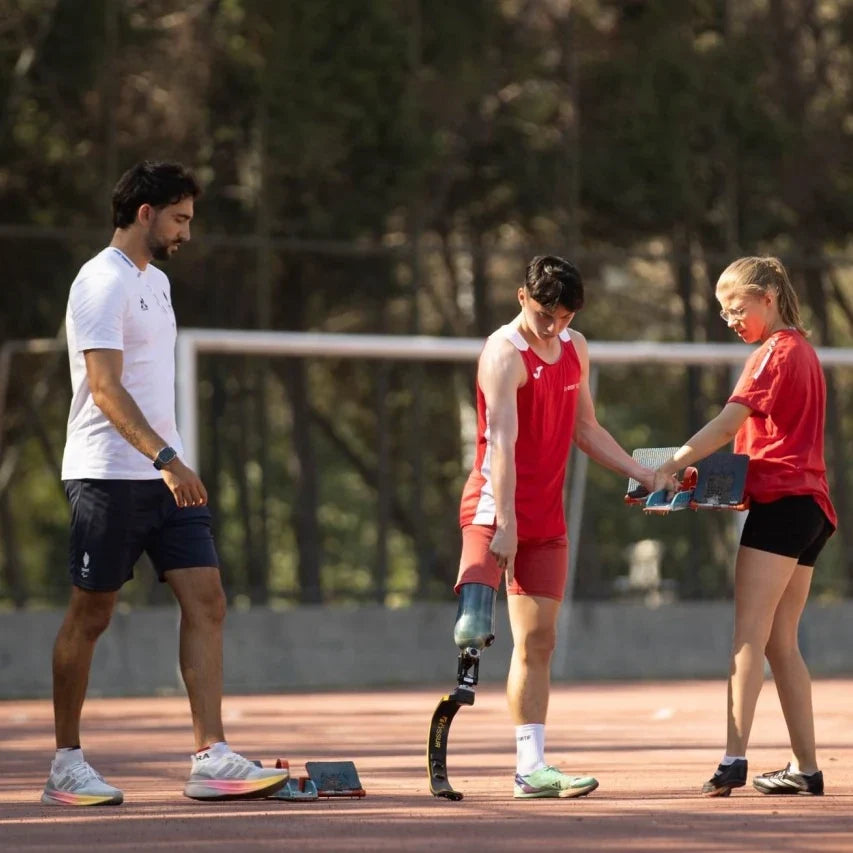
To see this principle up close, the QNT team spoke with Lucas Mathonat. A 400-meter sprinter, he became the guide of a blind T11 athlete, with whom he won the bronze medal at the Tokyo Paralympic Games. Today he coaches at INSEP, within the French para athletics team. His perspective is interesting because he has seen both sides: he was the athlete taking supplements before becoming the coach who does the planning and has to win athletes over. This article goes through the main questions from the conversation and tries to separate what the scientific data show from what experience on the ground tells us.
One idea keeps coming back in what he says, and it runs through this whole article: it is the training periods that call the shots, not the products.
Should you take supplements all year round or in phases?
The conversation starts with a training calendar, not a product.
When asked what he recommends to his athletes, Lucas Mathonat doesn't start with a list. He first explains how he builds the season: some periods are planned to be especially demanding, and it is around these peaks in training demand that he considers adjusting intake. The idea is to support the athlete, not to take supplements permanently. When the load goes up, nutritional needs may go up too, but that does not automatically mean adding supplements.
Framing it this way has an interesting practical consequence. The question shifts from “should I take this product?” to “where am I in my season?”, which an athlete and their coach know how to answer. It also implicitly assumes that everyday food can cover a large share of your needs when the load is lighter, a reminder not to confuse nutritional needs with a need for supplements.
“At some point, you also have to adjust your intake to match those high training demands.”
(Lucas Mathonat)
What the science says. Nutritional periodization is now a formal concept in the literature: intake is varied across the training cycle to support changing goals, instead of following a single plan for the whole season (Jeukendrup, 2017). The most widely cited protein recommendations are also given as a range rather than a fixed number, roughly 1.4 to 2.0 g/kg/day for athletes depending on the sport and the training load, which leaves room for exactly this kind of adjustment (Jäger et al., 2017). Periodization has mainly been studied for carbohydrates, so applying it to supplements is more a matter of practical reasoning than of direct experimental evidence.
In practice. Identifying the two or three most demanding blocks of the season ahead of time could be enough to shape your nutrition strategy, without having to rethink it week by week. Reassessing intake at each change of block, at the return to training, during heavy-load phases and during the taper seems more useful than constantly adjusting it. The opposite is also worth considering: lighter periods do not necessarily call for the same supplemental intake.

Figure 1. Schematic diagram of nutritional periodization, with intake reassessed at each change of training block.
Is protein only for strength training?
A stubborn belief holds that protein is for people who lift weights. Sprinting says otherwise.
On this point, Lucas Mathonat is categorical: all of his runners take protein, and he sees no reason to reserve it for strength sports. Yet the instinctive link between protein and muscle growth (hypertrophy) is why many athletics groups go without it, even where sessions are very demanding. The confusion is understandable, but costly.
His argument is simple and practical: as the training load goes up, it can become difficult to cover all your needs through meals alone, especially when time constraints or a reduced appetite make meals harder to organize.
“If you want to recover better, you need to supplement to get what you can't get from food alone.”
(Lucas Mathonat)
What the science says. Muscle proteins are constantly being broken down and rebuilt, and exercise speeds up both sides of this turnover. Measured using plasma amino acids, protein breakdown rises 30 to 50% above resting levels after a fasted strength training session, alongside synthesis, and the net balance stays negative if nothing is eaten (Biolo et al., 1995; Phillips et al., 1997). During 90 minutes of prolonged exercise, the amino acids that muscle does not metabolize are released 9 to 20 times more than at rest (van Hall et al., 1999). This faster turnover explains why athletes may need more than the 0.8 g/kg/day recommended for the general population. The International Society of Sports Nutrition puts their needs at 1.4 to 2.0 g/kg/day (Jäger et al., 2017), and a study using the indicator amino acid oxidation method puts them at 1.8 g/kg/day in endurance athletes on a high-volume training day (Kato et al., 2016). These protocols involved strength training and endurance exercise, not sprinting: they do not set a target for sprinters, but they do show that protein needs increase with physical activity.

Figure 2. How much protein a 75 kg athlete needs per day, and how it can be spread across the day.
In practice. Thinking in grams per kilo of body weight is more useful than assuming that protein, by nature, matters for some sports and not for others. Training load, goals, usual diet and personal constraints all need to be factored in. For a runner whose appetite is blunted by hard sessions, getting some of that protein in liquid form can make the daily target easier to reach. Of course, the right amount of protein does not remove the need for enough carbohydrate, which remains essential to support training sessions and performance.
What should you take right after training?
The rule on the track is simple. What the research says is a little less so.
After training, the rule Lucas Mathonat gives his group comes down to two options: either have the shake right away, or eat a meal very soon, even if that means topping up later. You can see the legacy of the “anabolic window” here, the idea that the minutes after exercise are supposedly decisive. The rule has the advantage of being clear, and that is probably where its practical value lies: it prevents people from forgetting, gives the end of the session a structure, and stops athletes from going home without having had anything.
Does that mean the window should be taken literally? The research calls for a more nuanced view. What it has mainly highlighted is how much total daily intake matters, more than any precise window of a few dozen minutes. So the rule is still relevant, but probably for a different reason than the one usually given: it makes sure the intake actually happens and makes it easier to organize, more than it takes advantage of a narrow window.
“Either you have your shake now, after the session, or you go and have a meal very soon.”
(Lucas Mathonat)
What the science says. A meta-analysis on how protein timing affects strength and hypertrophy did not confirm a narrow post-exercise window; total daily protein intake emerged as the deciding factor for adaptations (Schoenfeld et al., 2013). Taking protein close to training still has clear practical value, though, especially if the athlete trained on an empty stomach or the next meal is a long way off. During prolonged endurance exercise, an intake of around 0.25 g of protein per kilo per hour has also been proposed to limit markers of muscle damage (Jäger et al., 2017).
In practice. The “shake right away or meal soon after” rule still makes perfect sense as a simple way to stay organized, without needing a thirty-minute window to justify it. The first thing to look at could be your total daily intake, then how it is spread across the day. Context still matters, though: a fasted session, a late session or two sessions on the same day make eating soon afterwards important again.
Supplements: start with the calendar, not the product
A guiding principle emerges from this conversation: what matters first is not the list of products, but the moments when using them can meet an identified need. Starting from the training calendar, spotting the periods when training demands are genuinely high and reviewing intake at those points means treating supplementation as something you adjust, not a routine.
This way of thinking also sheds light on the two points covered above. Protein is not reserved for any one sport: whether it is relevant depends in particular on training load, goals and how well your diet covers your needs. How quickly you take it after a session still matters for organization, while the total you reach over the day remains the deciding factor for adaptations.
Lucas Mathonat is happy to admit that not all of his athletes are on board, and he doesn't push them. That may be the most sensible stance, since supplementation is neither a must nor a one-size-fits-all solution. It can be one tool among others to meet the demands of training, provided you know which need you are trying to cover and check that a supplement is genuinely necessary.
By Marius Grek, nutrition expert at QNT Sport.
References
Biolo, G., Maggi, S. P., Williams, B. D., Tipton, K. D., & Wolfe, R. R. (1995). Increased rates of muscle protein turnover and amino acid transport after resistance exercise in humans. American Journal of Physiology, 268(3, Pt. 1), E514-E520. https://doi.org/10.1152/ajpendo.1995.268.3.E514
Jäger, R., Kerksick, C. M., Campbell, B. I., Cribb, P. J., Wells, S. D., Skwiat, T. M., Purpura, M., Ziegenfuss, T. N., Ferrando, A. A., Arent, S. M., Smith-Ryan, A. E., Stout, J. R., Arciero, P. J., Ormsbee, M. J., Taylor, L. W., Wilborn, C. D., Kalman, D. S., Kreider, R. B., Willoughby, D. S., … Antonio, J. (2017). International Society of Sports Nutrition position stand: Protein and exercise. Journal of the International Society of Sports Nutrition, 14, 20. https://doi.org/10.1186/s12970-017-0177-8
Jeukendrup, A. E. (2017). Periodized nutrition for athletes. Sports Medicine, 47(Suppl. 1), 51-63. https://doi.org/10.1007/s40279-017-0694-2
Kato, H., Suzuki, K., Bannai, M., & Moore, D. R. (2016). Protein requirements are elevated in endurance athletes after exercise as determined by the indicator amino acid oxidation method. PLoS ONE, 11(6), e0157406. https://doi.org/10.1371/journal.pone.0157406
Phillips, S. M., Tipton, K. D., Aarsland, A., Wolf, S. E., & Wolfe, R. R. (1997). Mixed muscle protein synthesis and breakdown after resistance exercise in humans. American Journal of Physiology, 273(1, Pt. 1), E99-E107. https://doi.org/10.1152/ajpendo.1997.273.1.E99
Schoenfeld, B. J., Aragon, A. A., & Krieger, J. W. (2013). The effect of protein timing on muscle strength and hypertrophy: A meta-analysis. Journal of the International Society of Sports Nutrition, 10, 53. https://doi.org/10.1186/1550-2783-10-53
van Hall, G., Saltin, B., & Wagenmakers, A. J. M. (1999). Muscle protein degradation and amino acid metabolism during prolonged knee-extensor exercise in humans. Clinical Science, 97(5), 557-567. https://doi.org/10.1042/cs19980422



Frequently asked questions
Do runners need to supplement with protein?
Is the thirty-minute anabolic window real?
What is nutritional periodization?
What supplements does an elite sprinter take?
Keep reading
 Gain Muscle
How to Choose Protein Powder: The Ultimate 2026 Guide
Whey, isolate, casein or vegan? Learn how to choose protein powder for your goal, with a comparison table, the amino acid profile that actually mat...

Best time to take whey protein: the complete science-backed guide
When should you take whey protein? Morning, post-workout or before bed: discover the optimal timing backed by 6 studies. Expert guide by QNT Sport.

Protein Drinks: How to Choose Between Water, Shake and Powder
Protein water, ready to drink shake or powder: this guide compares protein, sugars and calories per serving to pick your protein drink. Made in Bel...
 Our Tips
Micellar casein: the slow protein for overnight recovery
Micellar casein before bed: what studies show on overnight muscle protein synthesis, the best dose and timing, casein vs whey and recovery the next...


